Saturday, July 27, 2013
Watchmen (Director's Cut)
Written by: Alan Moore, Dave Gibbons (graphic novel - writer and illustrator, respectively); David Hayter, Alex Tse (screenplay)
To start, I'm a huge fan of the original "Watchmen" graphic novel, and was very excited when I heard a movie was in production. I struggled to wrap my mind how they were going to adapt the complex narrative structure and visual dynamics into a linear film.
The truth was, they didn't. They distilled the story down to the core plot, removing most of the flashbacks and the "Tales of the Black Freighter" story-in-a-story. Still, what was left was still a pretty decent adaptation, though it was a very loose adaptation. Some elements are almost shot-for-shot reproductions, while others were changed significantly. (The most noticeable item that was removed was the fake giant alien squid invasion at the end, and I was rather bummed that it was changed.)
The acting in "Watchmen" is mostly not great. Most of the characters come off as cardboard. This is a major hinderance to the enjoyment of the film because it drags it down too often. At points, it felt like some of the actors were reading their lines without understanding why they were saying what they were saying. In retrospect, though, they were not given the greatest script to work with, focused too much on visuals and recreating dialogue that was written to be said by characters on a page.
This movie has grown on me more, as I've reflected on it. But the director's cut is far too long to enjoy, and it has too many flaws to ignore without much running in its favor. It is not, by any means, a comic book / superhero movie acceptable for children. And I wouldn't recommend watching it without any familiarity with the original source material.
Friday, November 23, 2012
The Soloist
Written by: Susannah Grant (screenplay); Steve Lopez (book)
This movie sets out to tell the true story of journalist Steven Lopez (Downey) and his attempt to help rebuild the life of Nathaniel Ayers (Foxx), a dispossessed man who once had the opportunity to be one of the great cellists. In that goal, it succeeds.
To it's credit, the movie does not reduce itself to sappiness. There is a tendency in telling stories like this to gloss over the ending, to reveal some major change. The struggling journalist learns the value of friendship and the need to help the homeless. The musical vagrant returns to greatness at his instrument. Instead, the ending is much more realistic. There is no transcendent moment. The characters have indeed grown, but the change is not monumental. I appreciate that the filmmakers decided not to fit a trite conclusion onto the film - that was not the point. They stayed loyal to the story (as far as I know it), even if that meant the conclusion does not satisfy in the usual sense.
My biggest disappointment in the movie was that I struggled to truly care about the characters. They failed to come alive, but rather felt exactly like people playing out a story that had already been written. I learned everything I needed to know about them from the trailer. This is not the greatest performance by either of the leads, though, to their credit, I appreciate that both worked outside their usual character style and tried for something different.
"The Soloist" felt like a movie that had a lot of potential, but didn't live up to it in the way that it could have. But maybe that's the point - the movie itself is about people not able to live up to expectations. I'm not suggesting that the filmmakers intentionally produced a movie that fell short of goals, but rather that it is fitting that it occurred - whether intentional or not. They tried for something different - to reveal something true, even if in their quest for veracity they opted not to resolve the problems of every character.
Sunday, August 12, 2012
Under the Dome
"Under the Dome" is one of Stephen Kings longest books, and it manages to showcase both his biggest strengths and clear weaknesses, often simultaneously.
To start with the positive: "Under the Dome" is ambitious. In it, King sets out to document the decay and downfall of society when faced with the unearthly challenge of being stuck under an impenetrable dome. And he absolutely succeeds. Yet, at the same time, this "documentation" is often too meticulous, providing more detail than anyone really needs or cares about.
"Under the Dome" has some of King's most fleshed-out characters in any of his novels. They feel almost real. (OK, maybe Big Jim is a bit over-the-top at points - but what car dealer isn't?) But too much attention is given to characters whose purpose is minimal and have no real affect on the story. At one point, we meet a character, and over the course of five pages we learn all about their family and personal history. A chapter or two later, that character is killed off. It's almost as if King never learned the difference between major and minor characters, and so everybody gets the "major character" treatment, regardless of their significance.
I'm not sure how else to characterize "Under the Dome" except that it represents Stephen King at both his best and his worst. If you're the type of person who likes Stephen King, you'll likely find what you like in droves. If you're the type of person who looks down on King's work, you'll find plenty to gripe about too. For me: I enjoyed it. I just wish it had been about 400 pages shorter.
Sunday, April 15, 2012
Art & Copy
Directed by: Doug PrayWednesday, February 29, 2012
Catching Fire
Written by: Suzanne CollinsMonday, December 19, 2011
Carriers
Written and Directed by: Alex Pastor, David PastorSunday, August 7, 2011
Surrogates
Directed by: Jonathan MostowSunday, June 12, 2011
2012
Directed by: Roland EmmerichMonday, March 21, 2011
Up

Monday, July 26, 2010
The Men Who Stare at Goats

Saturday, June 19, 2010
The Road

Monday, June 14, 2010
Read Hard

Edited by Ed Park and Heidi Julavits
For those of you who do not know, “The Beliver” is the monthly, non-fiction left-jab to “McSweeney’s” quarterly, fictional right-uppercut (although, considering I know nothing about boxing, I might have the whole metaphor flip-flopped). This book collects the best (arguably) pieces from the first five years of the magazine’s history and puts them in one place for those of us who either did not know the magazine existed or – as in my case – could not the darn periodical.
I added “arguably” to a sentence in my opening argument not because I did not feel that some of the essays were great, but rather because I could not tell whether some of the essays were great or not. One of the factors that makes “The Believer” such a fantastic magazine – the editors’ lack of inhibition in publishing essays regarding just about any subject or theme – also contributes to the book’s biggest weakness. For many of the essays, I could decipher that the piece was well written – but I lacked the cultural capital to make it accessible. Frankly, in some cases, I had no more than a shadowing understanding of what the essay was about.
The perfect example of this inability to relate to the essay is Franklin Bruno’s piece “In Praise of Termites,” which discusses the life and work of film critic Manny Farber. The article repeatedly referenced Farber’s writings on film theory – which I have not read, and I doubt most non-film major people have read. The article also discusses how Farber interpreted several movies which I have never heard of and, obviously, never seen. By the time I finished reading this seventeen page monster, I only had a vague understanding of Farber’s work.
The book does have many great essays, though. (And, in retrospect, I should have probably started by discussing those pieces instead.) One of my favorites is Paul LaFarge’s explanation / history / personal narrative regarding “Dungeons & Dragons.” LaFarge infuses D&D metaphors throughout the essay to help explain the game (such as “entering the cave” instead of “learning about the game). Yet, after introducing the essence and dynamics of the game to the readers, the essay shifts into a history of how the game was developed and what happened to the intellectual property rights. Finally, the third act begins a personal narrative of how the writer game to play a game of D&D with the game’s most recognized developer (there were many, we learn earlier).
Another fantastic piece – and perhaps my favorite – is “The Sinatra Doctrine” by Rich Cohen. Cohen’s essay fantastically weaves the story of the song “My Way” together with a the song’s most famous performers and how they came to sing it. We are strung along through a history which begins with Paul Anka writing the song as a farewell for Frank Sinatra, explains how that farewell actually revitalized Sinatra’s career, connects Sinatra’s disdain for rock and roll to how Elvis eventually began performing the song himself, and reveals how punk rock’s rejection of Elvis’s cooption of rock and roll’s soul led to the Sid Vicious performing the song. Ultimately, we are lead back to Paul Anka – the original writer (though he stole the tune from an unsuccessful French pop piece) – still performing his most famous piece of music, although he did not make it famous himself.
Other highlights include William T. Vollmann’s meditation on the destruction of war – “And Suppress the Unpleasant Things” – and Joe Hagan’s search for the greatest musician to ever disappear off the face of the earth – “Transit Byzantium.” Ginger Strand’s examination of the history and purpose of aquariums – “Why Look at Fish?” – was cute and enlightening. Jonathan Lethem’s “The American Vicarious” takes a snapshot of Nathaniel West’s short novels and their relevance to modern society, although I felt that it was over before the intellectual momentum began.
I recommend this book, but only for people who are ready for an intellectual workout and are not afraid to find out how little they actually know about significant parts of our modern American (or in some cases, international) culture. At least I can use what I found out I don’t know as a springboard to find out more next time I am at the library.
Thursday, April 8, 2010
Zeitoun

Friday, January 29, 2010
Manhood for Amateurs

Monday, January 18, 2010
Avatar
Wednesday, September 2, 2009
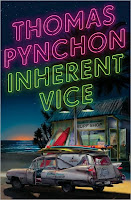
Inherent Vice


Saturday, August 22, 2009
Adam

Saturday, August 15, 2009
Terminator Salvation


