Monday, July 26, 2010
The Men Who Stare at Goats

Friday, July 9, 2010
Atonement

Tagline: “You can only imagine the truth.”
Director Joe Wright’s adaptation of Ian McEwan’s novel “Atonement” tells version of the fable “The Boy Who Cried Wolf” set in World War II England.
In the first act, Briony Tallis (Saoirse Ronan) has a crush on the one of her family’s servants Robbie Turner (James McAvoy), but her image of him is ruined when she reads an inappropriate note he had written to her older sister Cecilia (Keira Knightly) and when she stumbles upon the two in a private moment of passion. When another family member is sexually assaulted, Briony lies and says that she saw Robbie doing it, using the raunchy note as evidence.
In the second act, taking place a few years later in the midst of World War II, Bobby has volunteered to join the British army in exchange for his freedom. Cecilia, realizing her sister’s lie, renews their affair and they exchange letters and passionate visits. Of course, the irony (in case you haven’t caught it) is that he has put his life in danger to earn freedom from a crime he didn’t commit. The two carry on a passionate affair, always with the promise of returning to England together.
The third act involves Brioney (now played by Romola Garai) coming to terms with the effects of her lie. She volunteers as a nurse, only to realize (in a very graphic moment) the power of love compared to the brutalities of war. Briony tracks down her sister, only to have to confront both Cecilia and Robbie, home on leave, together. Although it is too late to change much, Briony agrees to write a letter to the court explaining that she had lied as a child. She leaves, ashamed, giving the lovers a moment of privacy before he needs to report to the front lines.
The film has a coda, though, set in contemporary times. Briony is now an old woman (played by Vanessa Redgrave), and reveals that her latest novel, “Atonement” – telling the story of the triangle of love, sin, and contrition we’ve been watching – is completely true. Except! (she reveals) that Robbie actually died as the British army was evacuating Dunkirk and that her sister was killed by a bomb during the Battle of Britain. The part where Robbie and Cecilia meet up was completely made up by Briony for her book, giving them the chance to be happy together that she had originally taken away.
(Phew! Enough plot summary for now? I think so.)
I guess my strongest criticism of “Atonement” is that it tries to be too many things – an epic, a love story, a period piece, with sprinklings of social commentary. If it had focused on one of these aspects, it would have been a much better film overall. For example, although the visual and emotional effects of the scene of Robbie at the evacuation of Dunkirk were incredibly powerful, I feel that this scene did not necessarily add any meaning or depth to the rest of the movie. Although I appreciated that the film did not shy away from the brutal realities of war – Robbie and Cecilia do not live happily ever after – the final visual of old Briony confessing her sins and working for atonement was little overboard. (If you don’t understand from watching the rest of the movie that writing the book and giving new life to the dead was her penance, then you must be dense.)
My other major problem is that the film was too darn literary. I mean, I understand that it was adapted from a novel, but for a movie with essentially three major characters there was too much time spent creating verisimilitude by developing background characters. I don’t mind symbolism either, but too many times in this movie the symbols were so blatant as to be intellectually jarring (such as how the characters are standing in relation to each other in the scene when Robbie is arrested). Even the moment of catharsis – a powerful scene in which Nurse Briony visits a dying soldier who recalls his lost love – is so telegraphed that there may as well have been a caption reading “THE MOMENT OF CATHARSIS – BRIONY REALIZES THE ERROR OF HER WAYS.”
Part of the reason I am so critical of this movie, though, is because it is so close to being great in my opinion, but just misses the mark. I want desperately to hold it in high esteem, but I restrain myself. It has all the traits of a great movie, but felt like everybody – the director, the actors, even the composer – were trying for a great movie. The music, the scenery, the costumes, the performances – everything felt like it was created with Oscar gold in mind.
So, ultimately, I will say that this was a pretty good movie. (I avoid saying that it was “enjoyable” because any movie in which the audience is exposed, in seriousness, to a man missing part of his skull is hard to call “enjoyable.”) I recommend it highly, and I wish I had seen it in the theatre. I just wish it could have been better, somehow.
Monday, June 21, 2010
Idiocracy

Wednesday, June 16, 2010
Bullets Over Broadway

Thursday, April 22, 2010
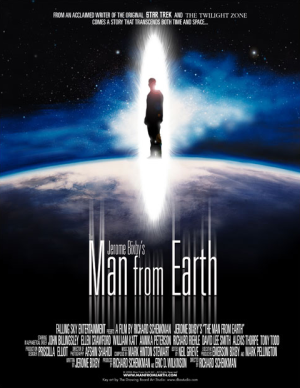
The Man from Earth

This film was recommended to me based on my interest in the writer’s previous work. In regards to production value, though, the movie is a bit too much like the television shows the writer was famous for – very low. From the very start, the movie is dialogue heavy with little action. In fact, almost the entire movie takes place with the group of characters sitting around and talking. The majority of the film is set with the characters sitting in front of the fireplace of a cabin, with a bunch of boxes in the background.
The premise of the movie (directed by Richard Schenkman) is based on a game of logic – trying to prove or disprove a point that can neither be proven nor disproven. If a man lived for 14,000 years, how could he possibly prove it? At the same time, if someone claimed to live for 14,000 years, how could someone possibly prove him wrong? Much of the early dialogue of the film is spent exploring this, to only come to the conclusion that one must either accept or reject the premise regardless of the proof. This idea, the necessity of proof, leads to the most interesting discussion of the movie.
It turns out, you see, that John Oldman was, in fact, Jesus. He claims that he actually came preaching the same essential ideas as Buddhism, but that his words were misinterpreted and that it was humanity who deified him into the Jesus despite his protests. This idea is reminiscent of Daniel Quinn’s “Ismael,” in which it is posited that much of the Bible is an interpretation of the natural social development of humanity. Anyway…
Ultimately, Oldman tells everyone that he’s not really 14,000 years old, and that it was just a cruel joke. Of course, we all know that he is merely appeasing them because he is just about to move on to begin a new life before people realize that he is not aging. There's also a "deus ex machina" moment right near the end in which one of the characters realizes that Oldman is actually his father, which did not seem to fit in with the rest of the film. The end of the movie occurs very suddenly, and really settles nothing.
What has been surprising to me is how well this movie was (generally) received by the critics. It didn't get wild reviews, but I was surprised at how many people were generally impressed by it. I was simply underwhelmed. It is based on a very intriguing concept, but the concept itself was not explored beyond the surface level. There are no flashbacks or scenes that take place away from Oldman's cabin. I've seen student-produced plays that have better staging and blocking.
So, despite the intrigue of the premise and the charm of the low budget, the movie was unsatisfying.
Monday, January 18, 2010
Avatar
Saturday, October 31, 2009
Sugar

Monday, September 21, 2009
Be Kind Rewind

Saturday, August 22, 2009
Adam

Saturday, August 15, 2009
Terminator Salvation

Monday, August 10, 2009
The Painted Desert

Tuesday, July 28, 2009
Juno

Monday, July 27, 2009
Gran Torino