Sunday, April 22, 2012
The Diving Bell and the Butterfly
Written by: Ronald Harwood (screenplay); Jean-Dominique Bauby (book)
I can't recall ever seeing a movie as stunning and striking and beautiful. Perhaps other movies have had one of two of those features, but never before have they all come together in such a powerful way.
Jean-Dominique Bauby (Amalric) wakes to find himself in a hospital, unable to move his body except to blink. He is trapped in his own mind, a victim of a massive stroke and "locked-in syndrome." Gradually, he learns to communicate through blinking as other recite letters. He attempts to come to terms with his permanent condition and the life he left behind - his job as an editor, the book he was writing, his children and their mother, his mistress, and his aging father (von Sydow).
To be honest, I am rarely at a loss for words. But in this case, I may have met my match. (Even my summary above seems pithy and unworthy of the film's plot.)
I highly recommend you see this movie. Just be prepared to encounter something incredible.
The story is heroic and tragic. The film is beautifully shot and edited. The acting is strong and heart-wrenching.
See it.
Thursday, December 29, 2011
The Assassination of Jesse James by the Coward Robert Ford
Directed by: Andrew DominikTuesday, June 14, 2011
The War
Directed by: Ken Burns, Lynn NovickThursday, July 29, 2010
Poor People

The heart of William T. Vollmann’s 2007 book on world-wide poverty is a simple question: “Why are you poor?” Yet the simplicity of most of the answers that he received from impoverished people throughout the world allowed him to write this reflection on the nature of poverty. At times powerful and depressing, this book exposes life under the poverty line all over the world and the reality of what it means to live, as Adam Smith declared, not being able to “afford to enjoy the necessaries, conveniences, and amusements of human life.”
Vollmann neatly breaks apart this longer philosophical work into several categories into which all of the chapters fit (with each chapter being, essentially, an individual essay or reflection), and so that is how I will break apart my discussion of his work.
In the first section, “Self-Defintions,” Vollmann provides us first with definitions which provide us the ability to discuss poverty, given that poverty itself exists as a somewhat abstract (if, at the same time, completely tangible) idea within the complex social-structure that is humanity. From here, he begins to paint us several portraits of poverty all over the world, from the drunk Sunee in Thailand to two beggar women in Russia (including their clearly disabled families) to two Japanese men who live under a bridge in Kyoto. These portraits are sometimes touching, sometimes disturbing, always interesting. From these sketches, Vollmann clearly reveals that poverty is not the same everywhere for everyone, including how the people came to poverty and even if the people consider themselves poor.
From here, Vollmann moves into his second section, “Phenomena,” in which he describes aspects of poverty evident at different levels in all poor people. These phenomena are invisibility, deformity, unwantedness, dependence, accident-prone-ness, pain, numbness, and estrangement. The most personally striking section is his explanation of how impoverished people everywhere suffer from invisibility, even though their suffering is evident. (Personally, it reminds me of the often deep poverty in which some of my students in Lynwood existed, though my ignorance often blinded me into denial of their circumstances.) Think about it – aren’t there parts of your own town, the poor part of town, that you won’t go? Through not driving through “skid row,” you have rendered those who live there invisible.
The third section, “Choices,” reveals choices which are not truly choices that the truly impoverished must live through in the attempt to escape poverty. He discusses the economic “amoritization” of labor to pay for freedom from poor circumstances, most often through prostitution, but sometimes through darker-than-mafia groups arranging marriages for visas at a massive human cost. Some, such as those in an oil town in Kazahkhstan sacrifice the poisoning of their health for new, nicer roads brought in by the American oil money.
Of course, Vollmann also touches on the “Hopes” that keep those who are in poverty use to keep surviving despite all of the odds being stacked against them. This hope of removal from poverty is most evident in the person of Gary, who gambles nightly on a lottery drawing that he knows is rigged. This hope also exists in the poor community which cleans its own toilet (really, a bowl) without any set outline of responsibility or consequences.
In the last section, “Placeholders,” Vollmann discusses his own personal feelings and experiences with poverty in proximity to his home. Most interesting, to me, was how he compassionately he interacts with the poor who vandalize his property, while, counter intuitively, he fears for the safety of himself and his property. Ultimately, Vollmann leaves us with no single answer or solution, aside from a reference to the pathetic United Nations call for “more aid, better directed.”
Aside from the hollow feeling left by the lack of any sort of positive resolution (and what did I really expect from a book titled “Poor People”), this book is fantastic. It effectively examines and reflects upon poverty through several lenses – statistics, science and psychology, personal experiences, and the visual. The use of photographs of most of those interviewed (except those who feared reprisal from authorities) makes every scene more vivid and powerful. Yet, at no point do Vollmann’s words request guilt or acceptance of blame from the reader. Instead, the book calls the reader to search his or her own soul and to examine his or her own thoughts and feelings about poverty. And, as such a thought provoking book, it is one of the best pieces of non-fiction I’ve ever read.
Friday, July 9, 2010
Atonement

Tagline: “You can only imagine the truth.”
Director Joe Wright’s adaptation of Ian McEwan’s novel “Atonement” tells version of the fable “The Boy Who Cried Wolf” set in World War II England.
In the first act, Briony Tallis (Saoirse Ronan) has a crush on the one of her family’s servants Robbie Turner (James McAvoy), but her image of him is ruined when she reads an inappropriate note he had written to her older sister Cecilia (Keira Knightly) and when she stumbles upon the two in a private moment of passion. When another family member is sexually assaulted, Briony lies and says that she saw Robbie doing it, using the raunchy note as evidence.
In the second act, taking place a few years later in the midst of World War II, Bobby has volunteered to join the British army in exchange for his freedom. Cecilia, realizing her sister’s lie, renews their affair and they exchange letters and passionate visits. Of course, the irony (in case you haven’t caught it) is that he has put his life in danger to earn freedom from a crime he didn’t commit. The two carry on a passionate affair, always with the promise of returning to England together.
The third act involves Brioney (now played by Romola Garai) coming to terms with the effects of her lie. She volunteers as a nurse, only to realize (in a very graphic moment) the power of love compared to the brutalities of war. Briony tracks down her sister, only to have to confront both Cecilia and Robbie, home on leave, together. Although it is too late to change much, Briony agrees to write a letter to the court explaining that she had lied as a child. She leaves, ashamed, giving the lovers a moment of privacy before he needs to report to the front lines.
The film has a coda, though, set in contemporary times. Briony is now an old woman (played by Vanessa Redgrave), and reveals that her latest novel, “Atonement” – telling the story of the triangle of love, sin, and contrition we’ve been watching – is completely true. Except! (she reveals) that Robbie actually died as the British army was evacuating Dunkirk and that her sister was killed by a bomb during the Battle of Britain. The part where Robbie and Cecilia meet up was completely made up by Briony for her book, giving them the chance to be happy together that she had originally taken away.
(Phew! Enough plot summary for now? I think so.)
I guess my strongest criticism of “Atonement” is that it tries to be too many things – an epic, a love story, a period piece, with sprinklings of social commentary. If it had focused on one of these aspects, it would have been a much better film overall. For example, although the visual and emotional effects of the scene of Robbie at the evacuation of Dunkirk were incredibly powerful, I feel that this scene did not necessarily add any meaning or depth to the rest of the movie. Although I appreciated that the film did not shy away from the brutal realities of war – Robbie and Cecilia do not live happily ever after – the final visual of old Briony confessing her sins and working for atonement was little overboard. (If you don’t understand from watching the rest of the movie that writing the book and giving new life to the dead was her penance, then you must be dense.)
My other major problem is that the film was too darn literary. I mean, I understand that it was adapted from a novel, but for a movie with essentially three major characters there was too much time spent creating verisimilitude by developing background characters. I don’t mind symbolism either, but too many times in this movie the symbols were so blatant as to be intellectually jarring (such as how the characters are standing in relation to each other in the scene when Robbie is arrested). Even the moment of catharsis – a powerful scene in which Nurse Briony visits a dying soldier who recalls his lost love – is so telegraphed that there may as well have been a caption reading “THE MOMENT OF CATHARSIS – BRIONY REALIZES THE ERROR OF HER WAYS.”
Part of the reason I am so critical of this movie, though, is because it is so close to being great in my opinion, but just misses the mark. I want desperately to hold it in high esteem, but I restrain myself. It has all the traits of a great movie, but felt like everybody – the director, the actors, even the composer – were trying for a great movie. The music, the scenery, the costumes, the performances – everything felt like it was created with Oscar gold in mind.
So, ultimately, I will say that this was a pretty good movie. (I avoid saying that it was “enjoyable” because any movie in which the audience is exposed, in seriousness, to a man missing part of his skull is hard to call “enjoyable.”) I recommend it highly, and I wish I had seen it in the theatre. I just wish it could have been better, somehow.
Friday, May 7, 2010
Listening Is an Act of Love (2007)

Wednesday, May 5, 2010
Gonzo: The Life of Hunter S. Thompson

An Oral Biography by Jann S. Wenner and Corey Seymour (2007).
Jann S. Wenner, founder and publisher of Rolling Stone, explains in the foreword that this book is basically an extension of the magazine’s tribute to Hunter Thompson after his death. That issue (if you were lucky enough, like me, to grab a copy) was almost completely dedicated to personal reflections from friends and celebrities on the giddy highs and violent lows that defined Hunter Thompson. This book completes that issue in the way that a great bonus disc can complete a great DVD set.
The book is broken apart into many vignettes about Thompson, told in the first-person, by those who were with him. The stories themselves are organized foremost by chronology, and then sub-divided by themes. The contributors consist of people from many aspects of his life, ranging from his childhood friends and neighbors, to his editors and celebrity friends. The stories also range from describing the wild, public side of Thompson, to his more private – almost sensitive – personal side.
Considering that Thompson’s favorite subject was, in many ways, himself, I was surprised to learn so much more about him than I had previously known. Parts of his life which had previously been out of focus, such as his childhood, became much more illuminated. Of course, it was also funny to read some stories that are already legendary – such as his crippling inability to meet a deadline and his superhuman tolerance for alcohol.
This last aspect, though, is also part of the book’s weakness. A few too many of the stories are re-hashes of prior stories, and the same story is sometimes even repeated a few times within this tome. At a few points, it drags on interminably, almost without aim, but yet, at other points, entire decades nearly vanish without comment. Too much time, I feel, is spent on details that did not change or add any meaning to what is already known. Surprisingly (though pleasantly), there is no lengthy discussion of his literary legacy or impact on writing – the book merely ends after his death.
It is hard to give a blanket recommendation for this book. If you have no idea who Thompson is, “Gonzo” is not the place to start. But, if you are already a Thompson fanatic, this book does not add much to his mystique either. I enjoyed this book merely as a reminder of a great writer – a man with so much control over his words – who could have been so much more, if only he had been able to control other parts of his life as well.
Thursday, April 22, 2010
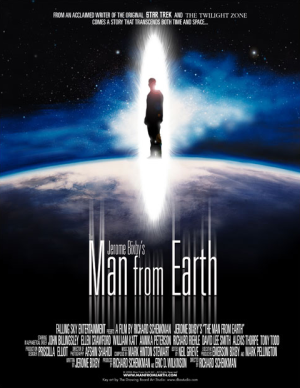
The Man from Earth

This film was recommended to me based on my interest in the writer’s previous work. In regards to production value, though, the movie is a bit too much like the television shows the writer was famous for – very low. From the very start, the movie is dialogue heavy with little action. In fact, almost the entire movie takes place with the group of characters sitting around and talking. The majority of the film is set with the characters sitting in front of the fireplace of a cabin, with a bunch of boxes in the background.
The premise of the movie (directed by Richard Schenkman) is based on a game of logic – trying to prove or disprove a point that can neither be proven nor disproven. If a man lived for 14,000 years, how could he possibly prove it? At the same time, if someone claimed to live for 14,000 years, how could someone possibly prove him wrong? Much of the early dialogue of the film is spent exploring this, to only come to the conclusion that one must either accept or reject the premise regardless of the proof. This idea, the necessity of proof, leads to the most interesting discussion of the movie.
It turns out, you see, that John Oldman was, in fact, Jesus. He claims that he actually came preaching the same essential ideas as Buddhism, but that his words were misinterpreted and that it was humanity who deified him into the Jesus despite his protests. This idea is reminiscent of Daniel Quinn’s “Ismael,” in which it is posited that much of the Bible is an interpretation of the natural social development of humanity. Anyway…
Ultimately, Oldman tells everyone that he’s not really 14,000 years old, and that it was just a cruel joke. Of course, we all know that he is merely appeasing them because he is just about to move on to begin a new life before people realize that he is not aging. There's also a "deus ex machina" moment right near the end in which one of the characters realizes that Oldman is actually his father, which did not seem to fit in with the rest of the film. The end of the movie occurs very suddenly, and really settles nothing.
What has been surprising to me is how well this movie was (generally) received by the critics. It didn't get wild reviews, but I was surprised at how many people were generally impressed by it. I was simply underwhelmed. It is based on a very intriguing concept, but the concept itself was not explored beyond the surface level. There are no flashbacks or scenes that take place away from Oldman's cabin. I've seen student-produced plays that have better staging and blocking.
So, despite the intrigue of the premise and the charm of the low budget, the movie was unsatisfying.
Thursday, November 19, 2009
You Don't Love Me Yet

Tuesday, July 28, 2009
Juno