Showing posts with label George Clooney. Show all posts

Saturday, September 1, 2012

The Thin Red Line

Directed by: Terrence Malick

Written by: James Jones (novel); Terrence Malick (screenplay)


It's not often that the words "beautiful" and "war film" go together.  But, if ever they were, it would be in regards to "The Thin Red Line."  Malick brings his unique visual style and vision to a genre which is rarely ground-breaking and is more often stale.

Although the movie loosely follows the American invasion of a pacific island during World War II, it's hard to point to any central plot beyond the general invasion.  There are recurring themes and inter-personal conflicts, but characters come and go in an almost arbitrary fashion.

Woody Harrelson's performance is absolutely fantastic and is worth noting here.  His part is small, but powerful.  It's also emblematic of the film as a whole - small and excellent parts which come together in a fantastic whole.

"The Thin Red Line" is not your typical war movie.  But Malick is not your typical director.

There's not a whole lot else I can say.  It's quite an experience to see a film like this, which stakes its own territory in the world of cinema and sets itself apart.

Saturday, January 28, 2012

The Ides of March

Directed by: George Clooney

Written by: George Clooney, Grant Heslov, Beau Willimon


It's not too often that a good political thriller comes along anymore, but "The Ides of March" fills that need exceptionally well.

Stephen Meyers (Gosling) is an up-and-coming campaign strategist who has hitched his wagon to the presidential primary campaign of Governor Mike Morris (Clooney) because of Morris's take-no-prisoners and tell-no-lies style. But when Meyers is contacted by a rival campaign manager (Giamatti), it begins a chain of events that threatens to destroy Meyers's career and derail the Morris campaign entirely. It is in this face of adversity that the characters reveal their true selves and what they are willing to do to take power.

To start, the acting in this film is fantastic. Gosling is just about the weakest link, and it's merely because he under plays his part, which is a bit tough to deal with given that he's protagonist. Marisa Tomei's character of the nitty-gritty-political-journalist is completely unnecessary except to advance one minor plot hitch, but she does a solid job considering the minor role. Clooney and Giamatti are at the top of their game, as is Philip Seymour Hoffman.

What this film does exceptionally well, which has not yet been tackled by a modern political thriller, is show the workings of a modern campaign. Not since "Primary Colors" has a high-profile film tried to cover contemporary election tactics. And "Primary Colors" was based clearly on the Clinton campaign, but "The Ides of March" is not based on an actual campaign, although there are references and allusions to some recent strategies.

There movie does rely on a cliche plot twist at a major key point, which is rather disappointing. (I can't give it away here, as it is basically the climactic turn.) I just felt that with all the creative starts and turns, there could have been something more original to use at that point. To give credit, that one twist was predictable, but how that twist plays out and affects the story is more more effectively done.

Kudos to Clooney for making the film. It was effective and enjoyable.

Sunday, August 7, 2011

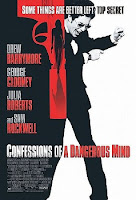
Confessions of a Dangerous Mind

Directed by: George Clooney
Written by: Charlie Kaufman (screenplay), Chuck Barris (book)


There are movies that are true. There are movies that are fiction. And then there are movies like "Confessions of a Dangerous Mind" in which the truth and fiction bleed together.

The movie is an "unauthorized biography" of TV producer Chuck Barris (Rockwell) known for creating and developing shows such as "The Dating Game," "The Newlywed Game," and "The Gong Show." As he rises to the top - or, to some, bottom - of television celebrity, he is simultaneously dragged into working for the CIA as an international assassin. All the while, he strings along long-time girlfriend Penny (Barrymore). The question is, how long can he keep up the juggling act? And which will destroy him first - his secret agent work, his television career, or his hollow love life?

(Side note: In this post, any reference to "Chuck Barris" will be a reference to the character in the film, not necessarily the real person. Although I realize that Barris is a real person and that the film purports to tell his life story, it is obvious that much embellishment and dramatization occurred. So, to prevent confusion, and to make the text clearer, Barris will simply be described as a fictional character.)

George Clooney's rookie effort as a director was strong, but ultimately evident as a rookie effort. The film's strengths lie in its actors and its stories.

All of the actors, from Rockwell and Barrymore on down - including Clooney himself, Rutger Hauer, and a brief appearance by Maggie Gyllenhaal - are absolutely fantastic. The characters are rich and consuming, and at no point does the audience slip into thinking of the actors as actors. Each performance is compelling and believable, although the plot of the film pushes the extent of belief.

The film follows three different story threads out of Barris's life: his TV production work, his romantic affair with Penny, and his involvement with the CIA. Each of these angles could have been a separate movie, but are combined and balanced in this film. In this way, we see Barris as a much more complex and deep character than if we'd only been exposed to one side of his life. The three different stories are juggled around well, always leaving you wanting more of one before moving on to the next.

One problem with the film was that it could have been edited down a bit. A few scenes run longer than necessary, and a couple scenes were harder to place within the larger narrative arcs. (Admittedly, these parts had significant symbolic value - but a symbol is most effective when grounded within the story itself and not used tangentially.)

The visual style was artistic and jarring. Unfortunately, it felt like some of the shots and design was used simply to use those specific shots and design. Again, like the symbolic scenes, these features could have been more effective if they'd been used as an element to advance the story. Instead, by the end, they'd lost their value.

The movie was impressive and is well worth watching, if only to see Sam Rockwell dominate his role in a way few actors could have accomplished. Don't be discouraged by the challenges presented in the first few scenes - it pays off later. Although Barris's life may have collapsed like a house of cards, this movie does not.

Monday, July 26, 2010

The Men Who Stare at Goats


Tagline: "No Goats, No Glory."

Bob Wilton (Ewan McGregor), a small-town journalist desperately trying to impress his estranged wife, travels to the Middle East to cover the Iraq War. On his way, he runs into Lyn Cassady (George Clooney), who reveals that he's a psychic soldier on a secret mission. Turns out, as Cassady explains, that in the 1980s the Army trained a whole unit - the New Earth Army - to use new age strategies to fight the wars of the future, led by Bill Django (Jeff Bridges). But, alas, a power struggle ensues with one trooper, Larry Hooper (Kevin Spacey), fracturing the group. Using his psychic mind and intuition, Cassady leads himself and Wilton to a secret base in the middle of the Iraqi desert. Apparently, after the New Earth Army was dismantled, Hooper founded a Blackwater-style group and is making major money launching psychic warfare. Ultimately, Cassady and Django decide to sabotage Hooper's operation by spiking all the food with LSD and then they go riding off into the sunset, never to be seen again and leaving Wilton to try to report the strange tale.

This movie is good. Not great, but good. But, if it isn't already evident, the movie is hard to explain in conventional terms as well. It isn't quite fiction, but it isn't quite non-fiction either. (The opening title states "More of this is true than you would believe.") For a movie that seems to drag on at points, it is surprisingly short.

The hazy gray middle area that this movie occupies is ultimately what held it back. Cassady is so strange, crazy, and off-the-wall that I'm not sure whether I'm supposed to laugh at his absurdist ideas or to pity him for his disconnection from reality. At times the movie is artistic journalism, self-discovery journey, road trip, social commentary, and comedy. None of these are necessarily exclusive from one another, but too many of them packed into just shy of 90 minutes pulled my mind around too much. There were even just a few too many big-name actors thrown into such a short script. (And, I'm not complaining, but it seems like Jeff Bridges can now only play "the washed-up ________ trying to redeem himself." Insert "hippie" for this movie, "country singer" for "Crazy Heart," and, probably, video game programmer for the new "Tron.")

Despite my final confusion, I can easily say that I enjoyed watching the movie. All of the leads - Clooney, McGregor, Bridges, Spacey - were fantastic, dynamic characters. The rich colors of the sets and scenes gave a sense of being just on the edge of reality, without falling away to fantasy. The best comparison I can think of is that this movie is like a grilled hamburger - good on its own, but a few more spices could have made it much better.

Directed by: Grant Heslov
Written by: Peter Straughan (screenplay) and Jon Ronson (book)