Showing posts with label 2011. Show all posts

Monday, July 13, 2015

Take Shelter

Written and Directed by Jeff Nichols


This movie has a lot of what I look for in a movie. Strong cast. Strong script. Strong cinematography. It's subtle and beautiful and manages to excel without needing to go over-the-top.

The movie has a beautiful, unclear ending - not necessarily ambiguous, but certainly unresolved. I appreciate that that writer/director Nichols didn't bother to spell it all out. We're left with something to talk about. The ending alone makes the movie worth watching, but the rest of it is so well executed that it doesn't feel like a "twist" or a "gimmick." It's just left there to be considered.

Most of what I've read about "Take Shelter" online focuses on Michael Shannon's performance. And he, indeed, shines. He is haunting and powerful and real at a level rarely achieved in acting. He steals the show, no doubt about it.

But I also believe Jessica Chastain deserves significant credit as well. Her stability serves as a counterpoint to Shannon's instability. Like Shannon, she manages to be "real" without resorting to "gritty." You feel for her.

I'd love to have a discussion on what the movie means, if anything. And I love the fact that the movie allows so much to be discussed. I think that too often writers and directors are afraid to leave anything ambiguous or open ended. Jeff Nichols does not have that problem, and I think him for it.


Tuesday, January 1, 2013

Darth Paper Strikes Back

Written by: Tom Angleberger


In this second book of the "Origami Yoda" series, a villainous Darth Paper shows up to wreak havoc with the Origami Yoda universe.  Not quite as charming as the first book, but at least a fitting sequel.

Monday, September 3, 2012

Catching Hell

Directed by: Alex Gibney


On October 14, 2003, Cubs fan Steve Bartman reached for a foul ball and, instead, caught the rage and vitriol of every other Cubs fan around the world.  "Catching Hell" attempts to unravel the events and outcomes of that infamous night.

The "Steve Bartman incident" is well documented around the internet, so I don't feel the need to rehash it all here.

"Catching Hell" covers much more than just the sequence of events that night, though.  Director Alex Gibney discusses multiple aspects of the Bartman incident, including how the media covered it and the way the security team at Wrigley Field tried to defuse the situation.  In a bit of meta-documentary, Gibney places the Bartman incident in historical context, comparing it to the Buckner play of 1986, to discuss how and why some people become "scapegoats."

I have to say that "Catching Hell" was a solid documentary, with enough explanation for those who are not familiar with what happened, while also introducing enough new information and reflection to make it interesting to those who remember exactly when it happened (like me).


Saturday, September 1, 2012

The Art of Fielding

Written by: Chad Harbach


I'm always wary when a book comes with a lot of praise (in case I haven't said that before), but I also can't help but be intrigued.  In this case, the praise wasn't totally unearned, though it was not quite as great as it could have been.  "The Art of Fielding" had clear strengths and weaknesses which fell across clearly identifiable lines.

The novel, as a whole, is centered around college baseball player Henry Skrimshander, who has an uncanny ability to field the ball (thus giving relevance to the title).  Although Skrimshander is the central character, he only represents a fraction of the novel's plot.  The rest of the book examines the lives of other characters who are all connected through how they know Henry.  And that's where the novel falls apart.

The portions about Skrimshander are the most fascinating in the book, and could have (probably) stood on their own as a smaller novel.  He is, by far, the most interesting character in the book, and I spent a lot of the time away from him wondering when he was going to reappear.  ("When are they gonna get to the fireworks factory?")  Unfortunately, there are so many other major characters that there are massive swaths of text in which Henry is totally absent.

Harbach's prose is especially successful when describing the baseball games, and for this I applaud him.  There are very few books about baseball which accurately describe the game.  Harbach manages to infuse those scenes with the grace and elegance that baseball deserves, without dropping any of the intensity of the game's competition.

There's an old piece of writing advice: "Write what you know."  It felt like, at times, Harbach decided that he really knew about "the small-college experience" and just ran with that concept.  But this strategy can be problematic because at points the novel seemed to be a one-trick pony.

"The Art of Fielding" was pretty good, though it wasn't great.  That's what I'll end with.

Friday, June 29, 2012

The Rum Diary

Directed by: Bruce Robinson

Written by: Bruce Robinson (screenplay); Hunter S. Thompson (novel)


Before he became famous for his "gonzo" journalism, Hunter S. Thompson wanted to be the next F. Scott Fitzgerald.  His first and only novel "The Rum Dairy" has floated around for many years, waiting to be adapted into a film.  Thanks to the spearheading work of Johnny Depp, it finally got made (for better or for worse).

To simplify the plot: Paul Kemp (Depp) arrives in Puerto Rico as an aspiring journalist.  Massive amounts of alcohol are consumed, as well as some drugs, and general anarchy ensues.  (There's also a conflict involving Aaron Eckhart and his girlfriend, but it's basically just filler.)

In all honesty, "The Rum Diary" was not great material to begin with, and there wasn't a whole lot that could have been done to salvage this bomb.  I love Hunter S. Thompson, but fiction was not his strength.

Giovanni Ribisi's performance is one of the few highlights of the film.  I'd almost say that the film is worth seeing just for him.  But it's not.

Unfortunately, "The Rum Diary" is the type of movie in which all the best clips are thrown at you in the trailer.  There simply isn't a whole lot driving this film forward.  It meanders.  It wobbles.  The talent in the film - Depp, Eckhart, etc - don't shine in their usual way.

I hate to say it, but "The Rum Diary" simply fizzled.

Sunday, June 24, 2012

X-Men: First Class - Revisited

Every once in a while, I'll watch a movie again.  (Shocking, I know.)  I've created a little "Revisited" label to use for occasions like this when, after a second viewing, I have something to add to my previous comments.

First up on my "Revisited" trek: "X-Men: First Class"


What struck me most about "X-Men: First Class" this time around was the way the whole film seemed to feel like a comic book.

Obviously (and I mentioned it last time), the montage sequence used several film panels, which  provided a comic book effect.

The staging and framing of several scenes mimicked the way it might have played out in a comic.  One scene that stands out for me that fits this motif is early in the film, when Xavier is flirting with the college girl at the bar.  I could almost see his lines in a dialogue bubble above his head.  When Raven interrupts him, her entrance into the scene was perfectly framed for a comic book panel.

Another key sequence which shot-for-shot felt more like a comic book panel was the climax, when Magneto kills Shaw.  The way the camera panned from left to right (like someone reading), following the coin through Shaw's skull while also cutting to shots of Xavier panning at the same speed - awesome!

The movie did have a lot of fluff.  Too many characters were developed, only to be killed off or pushed into the background.  The movie was paced out with enough action and plot development to keep it from feeling too long (which it was, to an extent).

Here's to hoping, like Christopher Nolan's "Batman Begins," that "X-Men: First Class" is merely the beginning of an epic series.

Sunday, June 3, 2012

Drive

Directed by: Nicolas Winding Refn

Written by: Hossein Amini (screenplay); James Sallis (book)


This film came highly recommended from several friends and critics, and when one friend told me it was on Netflix Instant, I immediately made the time to see it.  I was not disappointed.

The main character, forever unnamed (Gosling), is a getaway car driver who spends his days working as a mechanic.  Unfortunately, his boss (Cranston) has some ties to the mob (Brooks, Perlman) that he can't quite get away from.  Meanwhile, the driver has begun courting his neighbor (Mulligan) while her husband is in jail.  When the husband gets out, the driver agrees to help him on a heist.  The robbery is a bust and the husband is killed, and the driver is left to tie all the pieces together before it's too late.

Rarely do action-flicks have any sense of art.  Simultaneously, art house movies rarely have a good grasp of action.  "Drive" is that rare film that has an excellent balance of cinematic art and hard action.

The actors really make the characters come to life in "Drive."  Gosling breaks from his usual "handsome guy" mold for this character.  (OK, he's still handsome, but he's also incredibly violent.)  Albert Brooks, so often the funny guy recently, reveals perhaps his darkest character.  Bryan Cranston is absolutely believable as the man who is always a day late and down on his luck.  Even the hammy Ron Perlman and over-played Carey Mulligan manage to shed their stereotypical roles for a while.

This movie doesn't have a lot of dialogue.  Mainly because it doesn't have to.  In this, it's masterful at telling an entire story in only a few words.  It trusts that the audience can make inferences about things that are only referred to as tangents.

There is some shocking violence, but it's not gratuitous or unnecessary.  Rather, it's used as another medium of through which things are revealed about the characters.  (When you see it, think about which characters use which weapons and what that might say about them.  Come on, folks!  This isn't rocket science!)

If you haven't seen "Drive" yet, I'd definitely recommend it.

Monday, May 28, 2012

Take Me Home Tonight

Directed by: Michael Dowse

Written by: Jackie Filgo, Jeff Filgo (screenplay); Topher Grace, Gordon Kaywin (story)


There's a special place in the world for the "party movie."  It's not a type of movie you can watch with any regularity.  You have to be in the right place, at the right time, in the right frame of mind.  But when all the stars align and luck is on your side, then it's the perfect time to see a movie like "Take Me Home Tonight." (I may have mentioned all this before when I wrote about "Dazed and Confused."  Forgive me if I'm a bit repetitive.)

Summarizing the plot would really serve no purpose for a movie like this.  Suffice to say, Matt Franklin (Grace) has an opportunity to impress his long-time crush Tori (Palmer) at the year's biggest bash, and the usual party antics ensue.  There's a subplot about his little sister (Faris) trying to decide between going to college or marrying her boyfriend (Pratt).  Oh yeah, and it's the 1980's.

The movie has some very memorable debauchery spread evenly throughout the plot.  This keeps the film moving forward from beginning to end.  Too often, a film like this stalls after two-thirds of the movie because the characters have run out of silly things to do, but this one manages to keep things fresh and interesting.

Unfortunately, beyond that, the movie doesn't hold much weight.

The whole "Hey!  It's the 1980's!" premise comes and goes when required for a joke, but is not consistently meaningful.  Instead, it seems more like an idea that was thrown around occasionally but never quite stuck.

The actors basically phoned it in.  Any of them could have been replaced with just about anyone else and it probably wouldn't have changed anything.  There weren't any standout performances or defining moments for anyone.  (The exception to this would be Demetri Martin - who can never be replaced.)

In retrospect, my introductory paragraph may have given the film more credit than it really deserved or earned.  "Take Me Home Tonight" is sub-par, even for a party movie.  But, that's not the worst thing in the world when you're looking for a party movie.

Sunday, May 27, 2012

The Ecstasy of Influence

By: Jonthan Lethem


Jonathan Lethem has always had a strong way with prose, and his novels are usually pretty well written.  But, personally, I've always found it just as interesting to hear him talk about his work, so I was excited to hear about a new collection of his non-fiction.

In the interest of saving time, I'm not going to do an essay-by-essay analysis of the text.  Instead, I'll just go over a couple of the highlights and touch on a couple of the weaker points.

The first few essays were the most fascinating for me.  In them, he discusses his time working in various bookstores across the country.  He analyzes both the day-to-day life of working as a bookstore clerk, as well as sharing some of the sub-cultures who roam the stacks.

The title essay "The Ecstasy of Influence" is also fantastic.  In it, he outlines - in what can almost be described as a manifesto - the importance of influence in literature or for any piece of artwork.  To prove his point, he reveals at the end that most of the essay itself had been culled from other pieces of literature.  It's a fascinating read and well worth tracking down online.

There are a few essays that were a little too experimental for my taste.  There is also a whole section of essays devoted to "The Mad Brooklynite" which I had a hard time connecting with, both at a literary level and because I have never been there personally.

Overall, "The Ecstasy of Influence" is a great collection, although it could have been trimmed down and cleaned up a bit.

Sunday, April 15, 2012

A Better Life

Directed by: Chris Weitz

Written by: Eric Eason (screenplay); Roger L. Simon (story)


There is an interesting history of immigration and social commentary in American cinema. Unfortunately, I neither have the time, nor the expertise to really get into it here. But, if you're interested, you can start by seeing 1983's "El Norte," or this film - "A Better Life."

In this movie, Carlos (Bichir) is an gardener living illegally in the US. In the attempt to gain upward mobility, in the hopes of keeping his son Luis (Julián) out of trouble, Carlos buys his own gardening truck. But it's a dog-eat-dog world, and his truck - along with all the hopes of his family - is stolen. Carlos and his son travel the streets of Los Angeles trying to find the truck without getting the attention of the LAPD.

This is a movie with a very serious message, and it tells it very seriously. Unfortunately, the film is occasionally very heavy-handed in the way it the issues are presented.

Overall, it's a good movie. The acting - especially from Bichir - is very good. The story has a good pace, reflective at times without becoming too slow. The drama is tense and multi-faceted. It all adds up to a good, meaningful flick.

The movie's biggest flaw (moral heaviness aside) is carried by the main character. Despite every obstacle put in his path, he's a near perfect character. He always manages to do the right thing, always has the right answer, never gets frustrated or angry. He's simply too perfect to be human, and it's frustrating as a viewer to watch a character with such impervious idealism. (I refer to this as the "Ned Flanders Effect.)

It's a movie worth seeing, for sure. In fact, it's very good. Just be ready for the moral heaviness that comes with it.

Thursday, April 12, 2012

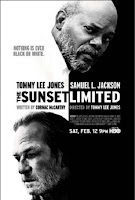
The Sunset Limited

Directed by: Tommy Lee Jones

Written by: Cormac McCarthy


There are very few writers who, by mere drop of their name, can make me sit up and pay attention. Cormac McCarthy is one of those writers. He adapted his own "novel in dramatic form" into a screenplay, which was then produced as an HBO special.

The plot is very simple: two men - known only as Black and White (Jackson and Jones, respectively) - sit in a room and debate the meaning of life. Prior to the opening scene, White tried to kill himself by jumping in front of a train but Black intervened and saved his life. Throughout their discussions, White (who reveals himself as a professor) points to the bleak sadness of life and the brutality of humanity. Black ( regularly counterpoints by pointing to humanity's redeeming qualities and the importance of faith. The power dynamic shifts back and forth repeatedly until, almost arbitrarily, it ends. The two part ways, neither side convinced by the other's arguments.

Going into it, one should know that McCarthy's writings are always incredibly dark and heavy, and "The Sunset Limited" is no exception. White beats the audience over the head with his depression and pessimism, and it can be emotionally draining to hear it, even in a performance. (And, to give credit, Tommy Lee Jones is pretty convincing in his role.)

I always enjoy movies with relatively ambiguous endings. (That isn't to say a film doesn't need resolution, but that it should always leave a few things for the audience to think about.) "The Sunset Limited" ends in a way that leaves things up for discussion. When White finally leaves, it is clear that Black's faith has been shaken but unbroken. Even though we never see him again, it's easy to conjecture (possibly incorrectly) that a similar change has happened to White. But what does it all mean? Who was right? Did either side "win"? Or is it even about winning at all?

Both Jones and Jackson give well-executed performances, although the nature of the story - taking place in a single sparse room on a single night - leaves little room for them in terms of action. Instead, they use their voices and the words they carry as their instruments. It was not a lot to work with, but they made it work.

Typically, McCarthy's works are filled with physical violence. "The Sunset Limited" is filled with emotional and philosophical violence. The two characters bludgeon each other with their points of view, hitting each other with point and counterpoint, ad nauseum.

"The Sunset Limited" is excellent, but I would not categorize it as a must-see film. Be prepared for an emotional roller-coaster if you do decide to watch it, but one that is well worth the experience.

Monday, April 9, 2012

Margin Call

Written and Directed by: J. C. Chandor


The economic collapse of the early 2000s went largely unnoticed by those who make films. There aren't many movies out there making overt reference to what was (and still is) one of the largest economic disasters of all time. For the most part, films have been depicting middle-class life just moving along like normal, ignoring the larger social context of the past five years. "Margin Call" is one of the few non-documentaries that I've come across to address this situation, using a fictional financial group (clearly based, at least loosely, on Lehmann Brothers and Goldman-Sachs).

Risk analyst Peter Sullivan (Quinto) is told to look at a project exiting manager (Tucci) had been working on, and what he finds is that his company's holdings are headed for disaster. Afraid of what the implications mean for the firm, Sullivan's boss Sam Rogers (Spacey) decides to call an emergency meeting that, ultimately goes all the way to the firm's CEO John Tuld (Irons). To ensure the survival of the company beyond the projected collapse, Tuld decides to order the immediate selling of all of the firm's toxic assets, despite Rogers's warnings that it would cripple the company and sever critical financial ties to other companies. Ultimately, the firm manages to dump their bad assets costing the firm hundreds of jobs as well, and Tuld tells Rogers that the firm took such harsh measures to weather the economic storm that they helped to create.

This movie was good, and one of its strongest aspects was the tension it was able to build by focusing on a limited time-frame and a limited setting. Most of the film's action takes place within a twenty-four hour period within a single building. Important decisions with massive ramifications must be made quickly, and one false move could mean the end of the company.

Another strength of the film was its ensemble cast. Everyone managed to play their part without overstepping anyone else. Irons was outstanding as the ruthless CEO, and Quinto dynamically played the up-and-coming analyst. Spacey managed to add a soft, sympathetic, human touch to his character who is forced to do things that will damage his reputation and his employees livelihoods.

There were a few rough-edges to this film that kept it from moving beyond "very good." Most notably, the presence of Demi Moore. Not only was her acting sub-par in this film (though, to be honest, she wasn't terrible), her character really didn't add much to the movie. I'm not sure what the character's purpose was at all. Her scenes felt like irrelevant fluff. Perhaps the only part that redeemed her role was the scene in which she interacts, brutally and bluntly, with Tucci's character.

It will take a lot longer for history of have a long enough scope to put perspective on this period in America. Still, when we get there, it will be important that we have some kind of cultural document - "Margin Call" - to show what happened when it all went down hill. It's not "The Grapes of Wrath," but it will do. For now.

Thursday, March 1, 2012

The Tree of Life

Written and Directed by: Terrance Malick


Few films in 2011 arrived with such praise and such controversy as Terrance Malick's "The Tree of Life." Opinion on the film was relatively divided. Many critics hailed it as genius, while popular opinion was mixed. Many theaters had to post their refund policies for this film, as many people demanded their money back after seeing it.

In terms of plot, there isn't much to say. A middle aged Jack (Penn) receives the news that his brother has died, which sends him flashing back to his childhood and reflecting on his parents (Pitt and Chastain), with a not-so-brief tangent tracing the creation of the universe and the development of life on this planet.

To start: This may be the most beautiful film I have ever seen. The visuals are stunning and powerful, especially with the ominous music behind it. Not a single frame of film was wasted.

I understand the complaints that there was no story. But, I don't feel that a story is necessary for this film. The purpose wasn't necessarily to tell a story, but to evoke an emotion and to make the audience think.

To fully appreciate "The Tree of Life," you should consider it a work of art rather than a "movie" in the traditional sense. There is little dialogue, little action, and few obvious connections between the scenes. The movie challenges to viewer to put together the puzzle pieces for themselves and come to create their own understanding of the film. (And, frankly, I love it.)

I've come to my own conclusion about what the film means, but I am also the first to admit that I do not have a complete understanding of the film. There are a few obvious biblical references - Job being the most clear - but there are definitely a lot more that I was not able to necessarily get my head around. Like a Rorschach test, what each viewer brings with them to the film can affect their interpretation.

Please go see this movie. Right now.


Sunday, February 5, 2012

Tinker Tailor Soldier Spy

Directed by: Tomas Alfredson

Written by: Bridget O'Connor (screenplay), Peter Straughan (screenplay), John le Carré (novel)


I reviewed the original novel here not too long ago, so I won't bother mentioning a plot summary. Let's just move straight into analysis here.

Going into it, I was worried that the running time of the film would require huge chunks of the novel to be truncated. The screenwriters did a fantastic job of keeping the core story together while making only minor alterations to the side stories. Aside from opening the film with what happened on the operation in Hungary (which is not revealed until near the end of the novel), the most important elements of the story were kept almost entirely intact.

The acting performances are all superb. Gary Oldman is excellent as George Smiley, though the character is intended to be mild-mannered and quiet. All of the supporting cast, such as Tom Hardy and Benedict Cumberbatch, really shine in their smaller parts.

Some of the symbolism, especially the bloody tear drop at the end, was a bit heavy-handed.

I did have one major blind spot in regards to this film - I'd already read the novel, so I knew what was going on. The major criticism I've heard in regards to this film is that so much of what goes on is very subtle that it becomes very hard to follow. I was able to follow it fine, but I can see where it might have been confusing for those not already familiar, especially in regards to the Ricki Tarr flashbacks and the sting operation at the end. There are also many tertiary characters - such as Bland, Alleline, and that bunch - whose roles and jobs are much more clear in the novel but are inserted in the film with little to no explanation.

It's nice to see a good spy film that doesn't resort to James Bond style action. The ideas of espionage and double-agents have fallen into darkness when it comes to spy stories. It was nice to see them revived.

Overall, I'd recommend this film. It's a bit long, but well worth it, if only for Oldman and Hardy's performances.

Sunday, January 29, 2012

Carnage

Directed by: Roman Polanski

Written by: Yasmina Reza, Roman Polanski


Based on Yasmina Reza's play "The God of Carnage," this film tells the story of two couples who have come together to settle a violent incident between their two children. But the road to hell is paved with good intentions, and things quickly turn sour between the two couples. Each character begins to suffer from various personal and emotional breakdowns as the dynamics of power and conflict continually shift, with the help of a few spontaneous moments (including one of the characters vomiting).

Personal and legal issues aside (and they are are to ignore), Polanski should be applauded for making such an emotionally intense film. The total running time is less than ninety minutes, but every minute is jam packed with tension. Adding any more length would have been more of the same.

As it is based on a play, the entire action of the film takes place in a single day within a single apartment. Polanski's use of close-ups and stationary cameras helps to enhance the claustrophobic effect. The characters pace around the rooms like animals in a cage.

Each of the actors does a fantastic job. Jodie Foster plays an uptight liberal mother better than any. (This is high praise, considering that I'm not a huge Foster fan.) John C. Reilly plays his usual slightly above-average Joe.

This movie is fantastic. It's hard to say I "enjoyed" it, but it is definitely worth seeing.

Saturday, January 28, 2012

The Ides of March

Directed by: George Clooney

Written by: George Clooney, Grant Heslov, Beau Willimon


It's not too often that a good political thriller comes along anymore, but "The Ides of March" fills that need exceptionally well.

Stephen Meyers (Gosling) is an up-and-coming campaign strategist who has hitched his wagon to the presidential primary campaign of Governor Mike Morris (Clooney) because of Morris's take-no-prisoners and tell-no-lies style. But when Meyers is contacted by a rival campaign manager (Giamatti), it begins a chain of events that threatens to destroy Meyers's career and derail the Morris campaign entirely. It is in this face of adversity that the characters reveal their true selves and what they are willing to do to take power.

To start, the acting in this film is fantastic. Gosling is just about the weakest link, and it's merely because he under plays his part, which is a bit tough to deal with given that he's protagonist. Marisa Tomei's character of the nitty-gritty-political-journalist is completely unnecessary except to advance one minor plot hitch, but she does a solid job considering the minor role. Clooney and Giamatti are at the top of their game, as is Philip Seymour Hoffman.

What this film does exceptionally well, which has not yet been tackled by a modern political thriller, is show the workings of a modern campaign. Not since "Primary Colors" has a high-profile film tried to cover contemporary election tactics. And "Primary Colors" was based clearly on the Clinton campaign, but "The Ides of March" is not based on an actual campaign, although there are references and allusions to some recent strategies.

There movie does rely on a cliche plot twist at a major key point, which is rather disappointing. (I can't give it away here, as it is basically the climactic turn.) I just felt that with all the creative starts and turns, there could have been something more original to use at that point. To give credit, that one twist was predictable, but how that twist plays out and affects the story is more more effectively done.

Kudos to Clooney for making the film. It was effective and enjoyable.

Tuesday, January 24, 2012

Young Adult

Directed by: Jason Reitman

Written by: Diablo Cody


Overall, I tend to look at Jason Reitman movies with a bit of bitterness. Partially because I find his tone a simultaneously smug and whiny. Partially because they seem like the kind of movies I would make if I had his pedigree and position. And partially because they're a heck of a lot better than if I would have made them. In any case, I have to say that I was pleasantly surprised by his most recent film - "Young Adult."

The film tells the story of Mavis Gary (Theron), a young adult novelist seemingly one bad day away from a nervous breakdown. When she gets an e-mail announcement about her ex-boyfriend's new child, Mavis decides to head back to her hometown and try to respark the love they once had. But Mavis's homecoming romanticism is put in perspective by Matt Freehauf (Oswalt), who pushes her to accept reality, all leading to the dramatic climax.

To start: Both Charlize Theron and Patton Oswalt give performances are out-of-this-world (although Oswalt's character's geekiness may or may not be too far from reality for him). Theron is adeptly able to play her over-the-top character with a masterful subtlety. Oswalt is somehow able to be charming and repulsive at the same time.

I'm not going to say the film is perfect. It isn't. I wouldn't even call it "great with a capital G." But it's definitely an excellent example of some of the recent heights of independent film production, and is well worth seeing.

Saturday, January 14, 2012

Captain America: The First Avenger

Directed by: Joe Johnston

Written by: Christopher Markus, Stephen McFeely


Oh Captain (America)! My Captain (America)!

The early part of the film is consumed with the back story of how puny Steve Rogers becomes the great Captain America (Evans), interspersed with the Red Skull (Weaving) rising to power. Later, when the super-soldier program is cancelled, though, Cap becomes a bond-selling sideshow, unable to fight the war he was made for. Ultimately, though, after proving his worth by rescuing some captured friends, he is recruited to destroy the super-secret evil HYDRA organization.

The Marvel comic book films have shown themselves to be solid productions, and "Captain America: The First Avenger" is no exception. But it does not strive to be anything more than what it is, and so it falls just a bit flat. I blame this partially on the character of Captain America - it's hard to create good drama with a character who is basically perfect. In fact, the point when the film dragged the most was when the filmmakers tried to artificially insert some personal drama into Cap's story with the whole war-bond side-show.

Overall, the classic tones of the film really worked. The styles and colors effectively created a world that reflected the comics of the time-period, giving a totally unique feel to the film. I really enjoyed this aspect of the film. It felt like a comic-book had come to life.

If you're the type of person that has enjoyed the previous Marvel films, then you're certain to enjoy "Captain America."

Monday, January 2, 2012

Red State

Written and Directed by: Kevin Smith


There's a lot I want to say about this movie, but very little of it is cohesive. Here goes anyway.

1. This film has two distinct halves. The first half is ostensibly a "horror" film, but the pacing slow and deliberate for that to work. The second half is more action-drama oriented, and better overall.

2. There was a lot of drama regarding Kevin Smith's strategies for funding and promoting this movie - most notably his attempt to auction it off at Sundance. That's all well-documented elsewhere. My only comment is that, although Kevin Smith may have felt he needed to be a bit of a showman to sell this movie, I feel that the movie was pretty darn good on its own.

3. By far, "Red State" is the most cinematic of Kevin Smith's films. The camera actually moves in some sequences (contrary to his usual stationary style), and some scenes use interesting angles to add to the effect. I mean, I'm not some kind of cinema snob, but as a Kevin Smith fan these changes and effects were very noticeable. It's nice to see him work outside of his comfort zone.

4. The climax of the film is fantastic. I can't comment on it much without giving it away, but I will say that it's not predictable. At all.

5. There are a couple of pretty gruesome sequences, though the actual gore is limited. Rather, it's the idea of what is being done which is what is most disturbing. This film is not for the faint of heart.

As a Kevin Smith fan, I recommend this movie. It's pretty good (hard to say "enjoyable"), though it does fall short of being great. Being prepared for the movie is key, especially knowing that the slow beginning pays off later, so keep that in mind.

Wednesday, December 28, 2011

Pearl Jam Twenty

Written and Directed by: Cameron Crowe


For twenty years, Pearl Jam has been a major force in rock music. From their rise during the early 1990s "grunge" movement to their current status as modern rock statesmen, their story has been one of triumphs and tragedies. In "Pearl Jam Twenty," Cameron Crowe attempts to weave together how the band got from here to there.

I loved this film, but much of that affection was predetermined by my relationship with the subject. My parents had The Beatles and The Rolling Stones. My sister had Depeche Mode and Metallica. I had Pearl Jam.

Although this documentary effectively summarizes the band's history, including major turning points (the battle with Ticketmaster, the Roskilde tragedy), I would not recommend it as a starting point for people. Some familiarity with the band and their music is necessary for some scenes, such as the footage of Stone Gossard and Eddie Vedder performing an incredibly rough cut of their song "Daughter." Even the title of the film is a reference for fans, but is lost on those completely unfamiliar.

"Pearl Jam Twenty" is pretty good, and as a Pearl Jam fan I highly recommend it. But, as a Pearl Jam fan, I also recommend you go out right now and buy all their records first. And then watch this movie. Rock on.