Showing posts with label Tommy Lee Jones. Show all posts

Tuesday, January 1, 2013

Lincoln

Directed by: Steven Spielberg

Written by: Tony Kushner (screenplay); Doris Kearns Goodwin (book - "Team of Rivals)


Abraham Lincoln is such a massive figure in American history, that it's hard to believe that any one movie could reasonably define him.  Of course, only Steven Spielberg could even reasonably attempt a movie of this scale.  And, for the most part, he was pretty successful.

Part of the film's success lies in its relativey limited scope.  "Lincoln" only shows the president at the peak of his leadership, nearing the end of the Civil War while he is trying to have the 14th Amendment passed and ratified.

Daniel Day-Lewis somehow becomes Lincoln (or, at least, how I always imagined him to be), but great performances are pretty much expected from him.

Thursday, April 12, 2012

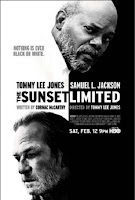
The Sunset Limited

Directed by: Tommy Lee Jones

Written by: Cormac McCarthy


There are very few writers who, by mere drop of their name, can make me sit up and pay attention. Cormac McCarthy is one of those writers. He adapted his own "novel in dramatic form" into a screenplay, which was then produced as an HBO special.

The plot is very simple: two men - known only as Black and White (Jackson and Jones, respectively) - sit in a room and debate the meaning of life. Prior to the opening scene, White tried to kill himself by jumping in front of a train but Black intervened and saved his life. Throughout their discussions, White (who reveals himself as a professor) points to the bleak sadness of life and the brutality of humanity. Black ( regularly counterpoints by pointing to humanity's redeeming qualities and the importance of faith. The power dynamic shifts back and forth repeatedly until, almost arbitrarily, it ends. The two part ways, neither side convinced by the other's arguments.

Going into it, one should know that McCarthy's writings are always incredibly dark and heavy, and "The Sunset Limited" is no exception. White beats the audience over the head with his depression and pessimism, and it can be emotionally draining to hear it, even in a performance. (And, to give credit, Tommy Lee Jones is pretty convincing in his role.)

I always enjoy movies with relatively ambiguous endings. (That isn't to say a film doesn't need resolution, but that it should always leave a few things for the audience to think about.) "The Sunset Limited" ends in a way that leaves things up for discussion. When White finally leaves, it is clear that Black's faith has been shaken but unbroken. Even though we never see him again, it's easy to conjecture (possibly incorrectly) that a similar change has happened to White. But what does it all mean? Who was right? Did either side "win"? Or is it even about winning at all?

Both Jones and Jackson give well-executed performances, although the nature of the story - taking place in a single sparse room on a single night - leaves little room for them in terms of action. Instead, they use their voices and the words they carry as their instruments. It was not a lot to work with, but they made it work.

Typically, McCarthy's works are filled with physical violence. "The Sunset Limited" is filled with emotional and philosophical violence. The two characters bludgeon each other with their points of view, hitting each other with point and counterpoint, ad nauseum.

"The Sunset Limited" is excellent, but I would not categorize it as a must-see film. Be prepared for an emotional roller-coaster if you do decide to watch it, but one that is well worth the experience.

Saturday, January 14, 2012

Captain America: The First Avenger

Directed by: Joe Johnston

Written by: Christopher Markus, Stephen McFeely


Oh Captain (America)! My Captain (America)!

The early part of the film is consumed with the back story of how puny Steve Rogers becomes the great Captain America (Evans), interspersed with the Red Skull (Weaving) rising to power. Later, when the super-soldier program is cancelled, though, Cap becomes a bond-selling sideshow, unable to fight the war he was made for. Ultimately, though, after proving his worth by rescuing some captured friends, he is recruited to destroy the super-secret evil HYDRA organization.

The Marvel comic book films have shown themselves to be solid productions, and "Captain America: The First Avenger" is no exception. But it does not strive to be anything more than what it is, and so it falls just a bit flat. I blame this partially on the character of Captain America - it's hard to create good drama with a character who is basically perfect. In fact, the point when the film dragged the most was when the filmmakers tried to artificially insert some personal drama into Cap's story with the whole war-bond side-show.

Overall, the classic tones of the film really worked. The styles and colors effectively created a world that reflected the comics of the time-period, giving a totally unique feel to the film. I really enjoyed this aspect of the film. It felt like a comic-book had come to life.

If you're the type of person that has enjoyed the previous Marvel films, then you're certain to enjoy "Captain America."

Monday, December 19, 2011

Harvard Beats Yale 29-29

Directed by: Kevin Rafferty


Harvard and Yale are known for their football programs. But in 1968, both schools faced off in their rivalry game with perfect records. Although Yale's team was heavily favored to win, Harvard manages to stay within striking distance for the last few minutes.

This documentary had a lot of potential. The game itself held plenty of action and drama, with participants and spectators including Tommy Lee Jones (who appears briefly in an unremarkable interview), Al Gore, and George W. Bush (who don't).

Unfortunately the film did not do justice to the story it told. Rafferty decided to forgo the typical narration of a documentary and instead used simple interviews tied together and interspersed with footage from the game.

I wanted to enjoy this movie. But I didn't. Although the interviews and clips were interesting, it needed narration to tie everything together. Without it, everything feels forced and disjointed.

This film may be worth watching if you're an alum of either university (or are related to one). The story of the game is worth knowing, but this documentary may not be the best way of hearing about it.