Showing posts with label Stanley Tucci. Show all posts

Sunday, June 3, 2012

The Hunger Games

Directed by: Gary Ross

Written by: Gary Ross, Suzanne Collins, Billy Ray (screenplay); Suzanne Collins (novel)


An adaptation of the hit YA distopian novel, featuring just about as many stars (and up-and-coming stars) as could be crammed into a modern feature-length film.

Overall, it was a pretty well-made adaptation.  In fact, some of the criticism has been that it was too close of an adaptation and lacked any originality.  I agree, to an extent.  The visual-effects were very loyal to the way everything was described in the novel, revealing things basically the way everyone imagined them.  It might have been nice to see a little creative license taken with some of the way things were presented or perhaps in the way the story unfolded.

There were a few kinks in the novel-to-film transition: mainly, a few things were glossed over or awkwardly inserted.  The stand-out example of this was the "tracker-jacker" explanation - the regular narrative stopped, pulled back to a sports commentary style to explain what the insects were, and then returned back into the regular narrative.

I enjoyed this movie very much.  But I'm not sure if I actually enjoyed it, or if I liked the original "Hunger Games" concept.

Monday, April 9, 2012

Margin Call

Written and Directed by: J. C. Chandor


The economic collapse of the early 2000s went largely unnoticed by those who make films. There aren't many movies out there making overt reference to what was (and still is) one of the largest economic disasters of all time. For the most part, films have been depicting middle-class life just moving along like normal, ignoring the larger social context of the past five years. "Margin Call" is one of the few non-documentaries that I've come across to address this situation, using a fictional financial group (clearly based, at least loosely, on Lehmann Brothers and Goldman-Sachs).

Risk analyst Peter Sullivan (Quinto) is told to look at a project exiting manager (Tucci) had been working on, and what he finds is that his company's holdings are headed for disaster. Afraid of what the implications mean for the firm, Sullivan's boss Sam Rogers (Spacey) decides to call an emergency meeting that, ultimately goes all the way to the firm's CEO John Tuld (Irons). To ensure the survival of the company beyond the projected collapse, Tuld decides to order the immediate selling of all of the firm's toxic assets, despite Rogers's warnings that it would cripple the company and sever critical financial ties to other companies. Ultimately, the firm manages to dump their bad assets costing the firm hundreds of jobs as well, and Tuld tells Rogers that the firm took such harsh measures to weather the economic storm that they helped to create.

This movie was good, and one of its strongest aspects was the tension it was able to build by focusing on a limited time-frame and a limited setting. Most of the film's action takes place within a twenty-four hour period within a single building. Important decisions with massive ramifications must be made quickly, and one false move could mean the end of the company.

Another strength of the film was its ensemble cast. Everyone managed to play their part without overstepping anyone else. Irons was outstanding as the ruthless CEO, and Quinto dynamically played the up-and-coming analyst. Spacey managed to add a soft, sympathetic, human touch to his character who is forced to do things that will damage his reputation and his employees livelihoods.

There were a few rough-edges to this film that kept it from moving beyond "very good." Most notably, the presence of Demi Moore. Not only was her acting sub-par in this film (though, to be honest, she wasn't terrible), her character really didn't add much to the movie. I'm not sure what the character's purpose was at all. Her scenes felt like irrelevant fluff. Perhaps the only part that redeemed her role was the scene in which she interacts, brutally and bluntly, with Tucci's character.

It will take a lot longer for history of have a long enough scope to put perspective on this period in America. Still, when we get there, it will be important that we have some kind of cultural document - "Margin Call" - to show what happened when it all went down hill. It's not "The Grapes of Wrath," but it will do. For now.

Saturday, January 14, 2012

Captain America: The First Avenger

Directed by: Joe Johnston

Written by: Christopher Markus, Stephen McFeely


Oh Captain (America)! My Captain (America)!

The early part of the film is consumed with the back story of how puny Steve Rogers becomes the great Captain America (Evans), interspersed with the Red Skull (Weaving) rising to power. Later, when the super-soldier program is cancelled, though, Cap becomes a bond-selling sideshow, unable to fight the war he was made for. Ultimately, though, after proving his worth by rescuing some captured friends, he is recruited to destroy the super-secret evil HYDRA organization.

The Marvel comic book films have shown themselves to be solid productions, and "Captain America: The First Avenger" is no exception. But it does not strive to be anything more than what it is, and so it falls just a bit flat. I blame this partially on the character of Captain America - it's hard to create good drama with a character who is basically perfect. In fact, the point when the film dragged the most was when the filmmakers tried to artificially insert some personal drama into Cap's story with the whole war-bond side-show.

Overall, the classic tones of the film really worked. The styles and colors effectively created a world that reflected the comics of the time-period, giving a totally unique feel to the film. I really enjoyed this aspect of the film. It felt like a comic-book had come to life.

If you're the type of person that has enjoyed the previous Marvel films, then you're certain to enjoy "Captain America."

Saturday, May 28, 2011

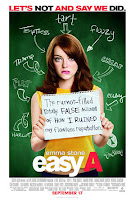
Easy A

Directed by: Will Gluck
Written by: Burt V. Royal


I must be totally up-front in admitting that this movie exceeded my expectations. That being said, my expectations were exceptionally low. Still, "Easy A" had its charms and moments which lifted it somewhat above the usual junk I had mistaken it for.

The movie begins with Olive (Emma Stone) accidentally telling a little white lie about her own promiscuity. When Marianne (Amanda Bynes) the leader of the campus Christian group hears, she turns it from a lie into a full-blown rumor which goes viral around the school. Olive decides to ride the rumor out, though, by taking on the public persona of an absolute whore. Meanwhile, behind closed doors, she's actually taking gift-card payments from her classmates to merely say that she's sleeping with them. Of course, as the lies begin to pile on top of each other, Olive's public and private lives begin to spiral out of control.

The film prominently features Olive wearing big red "A's" on her outfits in reference to Nathaniel Hawthorne's "The Scarlet Letter." Unfortunately, that's about as far as the literary and artistic merits of the movie go.

Too much of the movie felt aimless, directionless, and purposeless. This is especially evident via many of the supporting characers. For example, Thomas Hayden Church and Lisa Kudrow play a teacher-counselor pair working at the same school. Yet neither of their roles take on any importance, and they seem more like background furniture than relevant factors in the story. The same goes for Stanley Tucci, who plays Olive's father - I'm not quite sure what purpose his character served other than to deliver a few witty lines. I won't even mention the total waste of Malcom McDowell as the principal. Perhaps the most vibrant character is Marianne (Bynes), although that may have simply been because she is more of a caricature and less of a believable character.

For a straight-forward high-school comedy, though, this movie plays its cards pretty well. It admirably manages to balance a rather risque premise without lowering itself to using raunchy humor. There's a sub-plot about the boy Olive really likes, even though she's afraid to approach him given her reputation, and it comes across effectively - cute without being overly sweet.

I can't say I totally enjoyed this movie, but I can say that I didn't hate it, which is much better than I expected.