Written by: Tom Angleberger
"The Strange Case of the Origami Yoda" compiles a "case file" proving the wisdom of a paper Yoda. (And that makes even less sense than when I planned it in my head, but bear with me.) It's a fun young-adult book, well worth reading and crammed with enough Star Wars references to choke a wookie.
Showing posts with label 2010. Show all posts
Tuesday, January 1, 2013
Saturday, October 20, 2012
The Conspirator
Directed by: Robert Redford
Written by: James D. Solomon; James D. Solomon, Gregory Bernstein (story)
Most Americans know, at least vaguely, the story of the assassination of President Lincoln by John Wilkes Booth. Fewer are familiar with the trial of the conspirators who help hatch the plot.
Frederick Aiken (McAvoy) has been tapped to defend Mary Surratt (Wright), who has been accused of harboring the conspirators in her boarding house. But Aiken quickly finds out that, in the case of a military tribunal, justice may not be easy. He is further upset when he finds out the entire trial itself may be an attempt to draw out a Surratt's son from hiding, even if it means that she might be executed.
From the standpoint of story, "The Conspirator" weaves an interesting and emotionally charged tale. There are some interesting questions of ethnics and justice raised, mixed between plot twists (including a big one right near the end). The actors are solid, even if it felt that they were limited by the script and story itself.
The biggest issue with "The Conspirator" is that it fails to do anything new or novel. It tells its story in a generally straight and traditional way. It makes its point clearly, but does not present any new or challenging ways of thinking about the issues.
For better or for worse, "The Conspirator" felt like what it was: a historical drama. It's good, but could have done much more.
With Great Power: The Stan Lee Story
Directed by: Terry Dougas, Nikki Frakes, William Lawrence Hess
Written by: Nikki Frakes, William Lawrence Hess
Stan Lee is probably the most well-known name in the modern comic book world. Name a Marvel comic, and odds are it has his fingerprints on it somewhere. Yet, although he's lived in the public eye, much of his own personal history has been documented in mostly anecdotal discussions. "With Great Power: The Stan Lee" attempts to set the story straight about this influential writer.
This documentary strikes an excellent balance between telling Stan Lee's personal story and tracing his creative history.
I wouldn't say that "With Great Power" is for hardcore fans only, but it would definitely help to have a passing knowledge of the Marvel universe. There are a few points wherein Stan Lee spends a lot of time explaining the process of creating several of his famous characters, which can be tricky to follow if you're unfamiliar with those characters.
This isn't an example of great filmmaking, but it is a project with a lot of heart. I think the directors did a great job of framing the life and work of one of America's under-appreciated creative minds.
Sunday, September 2, 2012
Silly Little Game
Directed by: Adam Kurland, Lucas Jansen
With millions of people now playing the game, "Silly Little Game" provides the history of fantasy baseball.
There's not a whole lot else that can be said. It's an entertaining documentary, especially for those who play in fantasy leagues.
I found it fascinating how small it started - one group of friends who thought they knew more about baseball than each other - and how the first year was essentially a guessing game, as no real strategies had been developed.
It was also interesting how the people who originally developed and played the game eventually lost control of the rights to fantasy baseball, and so are no longer making money on the game they created.
"Silly Little Game" is short enough to watch in a free hour, and is entertaining if not informative.
Labels:
2010,
30 for 30,
Adam Kurland,
documentary,
Lucas Jansen,
Silly Little Game,
streaming
Wednesday, July 25, 2012
Hot Tub Time Machine
Directed by: Steve Pink
Written by: Josh Heald, Sean Anders, John Morris
"Hot Tub Time Machine" - the title pretty much reveals the central plot point of the film, while also giving away the basic absurdity of the premise. If you're not intrigued by the title, this movie probably isn't for you. (And even if you are interested by the title, there's no guarantee you'll like the actual result.)
Essentially, the movie tells the story of four men who accidentally turn their hot tub into a time machine. They're transported back to 1986 - specifically, to a night that served as a major turning point in all their lives. As they try to figure out how to return themselves back to their normal time period, they also realize that they have an opportunity to change the course of their lives.
"Hot Tub Time Machine" could have gone in one of two directions: either a straight comedy, or an an absurdist comedy (as the title would suggest). Unfortunately, it tried to be both at the same time, leading to an unevenness which scuttled the film. Some of the actors (such as Cusack) played their characters like just about any other comedy, but others (such as Robinson) played their characters with a wink-and-nod style. One or the other would have been fine, but with both it felt like the film couldn't decide which direction to take.
The 1980s element of the film added a bit of fun, and played off pretty well. (Those who made "Take Me Home Tonight" should have taken notes.) It may have only been important to the plot at a few points, but it was consistently used in the background to add to the atmosphere.
A special note should be made about Crispin Glover's performance as Phil, the ornery one-armed bell boy. It was a small role, but it was played to perfection. His presence elevated every scene he was in, and at some points I kept watching just in the hope that his character would pop up again (and I was not disappointed).
Overall, "Hot Tub Time Machine" wasn't great, but there were enough funny elements to make it worth seeing if you ever need to waste a couple of hours.
Tuesday, June 26, 2012
Ulysses and Us
"Ulysses and Us: The Art of Everyday Life in Joyce's Masterpiece"
Written by: Declan Kiberd
This book arrived with some critical acclaim, which originally drew my attention. The fact that it was written about James Joyce's "Ulysses" made it a must-have. But from there, it sat on my shelf for over a year, until around Bloomsday I decided to give it a read.
The basic thesis is that academics have stolen "Ulysses" from the rest of the world, though Joyce originally intended it to be read by everyone. (I agree and disagree with the thesis; more on that later.) From there, a significant portion of the book is dedicated to a chapter-by-chapter breakdown of the book, focusing on the "everyday" elements of the novel. It then wraps up with several chapters focusing on some major themes and motifs in the book, including the father-son relationship and Shakespeare.
I agree that not enough "everyday" people read "Ulysses." I disagree with Kiberd's assertion that the book has essentially been hijacked by the academic world. In fact, I would argue that, without the professors and grad students who devour the book like a formal steak-and-salmon dinner, "Ulysses" would have gone out of print a long time ago. I will not dispute that Joyce included many banalities of everyday life, nor that Joyce originally intended the novel to be read by as many people as possible. But "Ulysses" is not an easy read, even for a semi-intelligent person such as myself. Try getting through a chapter like "Oxen of the Sun" or "Circe" without an annotated guide, and you'll be lost in the woods.
I would argue that Joyce merged the "everyday" with the "academic," though he may have tipped the scales in favor of the academic in a few cases (again, see "Oxen of the Sun," "Circe"). There are many details from common life included on every page. He intended to make the novel as realistic as possible - including physical vulgarities which had never previously been hinted at in literature. But Joyce also had a masterful control of the language, and he used his abilities to create a multi-layered novel which could be appreciated in several ways. To claim that the academics have unfairly taken control of the book is to ignore the fact that Joyce (sometimes tongue-in-cheek) also included complex features for academics to savor.
There is also a bit of irony that, at points, Kiberd made arguments - such as the Bloom-as-Christ point - that would only be supported by an academic reading of the novel. Instead, that serves to show that the everyday and the academic were joined by Joyce to create what is, indisputably, the best novel off all time.
Labels:
2010,
Declan Kiberd,
James Joyce,
Ulysses and Us
Monday, May 28, 2012
Leap Year
Directed by: Anand Tucker
Written by: Deborah Kaplan, Harry Elfont
The premise is remarkably simple and saccharine: Hot-to-trot city girl decides to follow her boyfriend to Ireland to propose to him on leap day. Along the way, she meets a down-and-out country boy who teaches her that she doesn't really want what she thinks she wants. She is conflicted, then, about who she truly loves, has an epiphany, and they all live happily ever after.
Given that synopsis, you'd predict that this movie would be a gagger. And, to an extent, it is. But, it wasn't as horrible as I had thought it would be.
The movie had two major weaknesses holding it back.
The first: a plot so transparent it could be used as glass. This is a necessary evil in the rom-com genre, but it definitely made the movie feel longer than it needed to be because you could see every event in the plot coming several minutes ahead of time, and every minute in the interim between the moment you saw it coming and the moment it actually arrived was generally irrelevant.
The second: Amy Adams. This movie could have been better with just about anyone - including an inanimate cardboard cutout - in the main role. Whether it was a flaw in the writing of the character or in the way Adams tried to portray her (or, most likely, a combination of the two), there was very little to like about the main character. As an audience in a movie like this, we're supposed to root for the main character to find true love. But in this case, she was so absolutely not-endearing that I found myself hoping that there would be a twist in which the male lead would just abandon her on the side of the road. (Alas, it didn't happen.)
This was a pretty standard rom-com, and it definitely was held back from being rated even "decent rom-com" by these major issues. I don't feel like spending any more time re-living this film here.
Labels:
2010,
Adam Scott,
Amy Adams,
Anand Tucker,
Deborah Kaplan,
DVD,
Harry Elfont,
John Lithgow,
Leap Year,
Matthew Goode,
romance
Sunday, May 27, 2012
The Ghost Writer
Directed by: Roman Polanski
Written by: Roman Polanski, Robert Harris (screenplay); Robert Harris (novel)
I'm always looking for a good political thriller, and this Polanksi film came highly recommended.
When the original ghostwriter mysteriously dies, a new young writer (McGregor) is brought on to finish putting together the memoirs of a former British Prime Minister (Brosnan). Soon, though, as he spends more time working with the PM and his entourage, the more it becomes evident that there is a conspiracy. But what exactly is being covered up, and who is behind the conspiracy? Is it the PM's personal assistant (Cattrall) keeping state secrets hidden? Or his wife, hiding something personal? Or a political attack by his rivals? Or, perhaps, something even more sinister?
Polanski does a great job of pacing the story slowly, deliberately, without letting the plot drag on too long. Just when things are starting to feel too slow, he inserts a major twist or a new mystery to keep things moving forward. He quickly establishes the nature of the film in the opening sequence (the unattended car on the ferry), and from then on, each twist also escalates in complexity, leading to the biggest reveal at the end and the final, haunting shot.
There are obviously parallels that could be drawn between Brosnan's character and the real British PM Tony Blair. But it's not necessary to have any of that background to understand the film. If anything, the comparisons are almost an unnecessary distraction from the completely fictional story being told.
This was a really good movie, and really hit the spot in terms of what I was looking for when I decided to see it. It's rich, complex, and a bit dark.
Friday, April 13, 2012
Meek's Cutoff
Directed by: Kelly ReichardtWritten by: Jonathan Raymond
This movie came with a lot of critical acclaim, and so I had very high expectations. Luckily, it delivered.
Essentially, it's about a group of people who get lost on their way to the Oregon Territory. They begin to lose faith in the man they've hired to guide them. Tensions rise as water and supplies begin to dwindle and as it becomes clear that a stranger is stalking them.
"Meek's Cutoff" had just about everything that, I feel, makes a movie good. Simultaneously, some of these features can be rather off-putting for viewers who are unprepared for the daunting journey they are about to take.
For example: the film does not rely on dialogue to tell the story. In fact, there is basically no dialogue for the first ten minutes. There's an old writing class tip: "Show, don't tell." This film masterfully shows what is going on, without directly telling the audience. (At some points, that "show" borders on "tell" though - such as when in an early scene when one of the travelers carves "LOST" onto a dead tree branch.)
I appreciate some of the stylistic choices that were used in the film as well. Whispers are actually hard to hear - as whispers should be. When a conversation is being held far away, the audience can only hear it muted over the distance. We can hear the tone of the discussion, but not all the words. But, going back to the "show, don't tell" bit, we don't actually need to hear everything. We can extrapolate what is going on through what is given to us.
The plot itself is pretty basic, and only has one or two significant twists. What makes the story interesting, then, is the way the situation changes and how those changes affect the power dynamics between the characters. When faced with different challenges, each character's true nature is revealed. "Meek's Cutoff" shows that well-defined characters can super-charge a simple plot. Each actor did a great job, but special credit should be given to Bruce Greenwood who, as Stephen Meek, was not recognizable as anyone but Stephen Meek. The limited size of the cast, and their constant proximity to one another, gives the film an astounding feeling of claustrophobia despite the wide-open setting.
(There are sneaky spoilers hidden in this paragraph: so beware.) Lastly, the ending is absolutely ambiguous (and I've written previously how much I love that kind of ending). The travelers are no longer in control of their own destiny, but where the captured Indian is leading them - to safety, or to certain death - is uncertain. There's enough evidence provided to suggest either is a realistic possibility. The tree suggests that water is nearby, but it is still nowhere in sight. Salvation could be over the next hill, but that's been the feeling for the last several hills. As the film ends, there's an irony in the three families who set out West to forge their own futures not being in control of their own fates.
The weakness of the film is the slow, deliberate pace of the story, mainly because at one point it borders on tedium. Minimal action is fine, but there needs to be some forward movement occasionally or the energy dies out, which it almost does in this film.
I highly recommend this film. Be prepared, though, that it is not a typical movie. Go in with an open mind and you will be amazed.
Monday, April 9, 2012
Made in Dagenham
Directed by: Nigel ColeWritten by: William Ivory
It's hard to believe that as recently as the 1960s (and, in many ways, still today) that there was a major differential in pay between men and women. Although this discrepancy still exists, the formal legal structures that legitimized it have been destroyed. And some of that change began with the women who worked in the Ford factory in Dagenham.
When, as part of a new collective bargaining agreement, the Ford car company attempts to classify women's work as "unskilled labor," Rita O'Grady (Hawkins) and the other women at her factory go on strike. At first it is slow going, and as missed paychecks begin to add up, the solidarity of the union begins to break down. There is pressure from almost every side to give in - from the factory managers to husbands and children. But, when they get the attention of Britain's Employment Secretary, things begin to turn their way.
It's hard for me to separate my personal feelings and my analytical thoughts on this film. Suffice to say that the movie is well-made, but falls short of great.
On the positive side, it exposed a very real problem that still lingers in our society. It also showed the effects of a labor strike on the lives of those involved, not just in terms of work but also in terms of family life. The acting was solid, especially from the leads.
On the negative side, the film struggled to maintain a solid tone. At points there are moments of lightness and humor, at others moments of deadly seriousness. The film also built up too large of a cast to maintain, and so many characters remained static in the background, leading to character-story references that went unexplored.
I enjoyed the film, but I wouldn't say that anyone should go very far out of their way to see it.
Sunday, March 25, 2012
Mockingjay
Written by: Suzanne CollinsDepending on who you ask, "Mockingjay" is either the worst book of the series or absolutely amazing. I tend to fall in line with the latter.
And, please be warned, there have been spoilers lurking these paragraphs ahead.
After being dramatically rescued from the nasty Quarter Quell edition of the Hunger Games, Katniss finds herself part of the rebellion against the Capitol. Unfortunately, in the chaos of the rescue, her sometime-lover Peeta was left behind and is now a prisoner of the Capitol. Katniss struggles to find her place as part of the rebellion: she is important as a symbol and a figurehead, but President Coin of the rebellion is wary of giving Katniss too much power. As the rebellion begins its final assault on the Capitol, she struggles to keep herself and her family safe while also leading the way to a better, brighter future for all.
I think most of the criticism of this book stems from the fact that this book is, by far, the most cerebral of the novels in the series. This time, we spend a significant amount of inside Katniss's mind, in place of the action which dominated the earlier books. Katniss is a much weaker character in this book; she has been broken and beaten down too many times. Rather than driving the action of the plot forward, she is much more of a passive observer (especially in the early part of the book). She spends much more time thinking "deep thoughts" about the nature of abstractions like power and violence, good and evil (and, yes, a few moments thinking about Gale/Peeta dilemma). It is not until the final few scenes that the strong-willed Katniss returns.
This departure from the standard established in the first two books is a turn-off point for many readers, who were hungry (pun intended) for more of what they got before. I actually appreciated this change, though. It always felt like there were bigger philosophical issues hidden underneath the plot, but that those issues were always neglected in favor of keeping the story moving forward. But, if Katniss were as intelligent as she showed herself to be, these things must have crossed her mind at some point, and, finally, in this book, we get the chance to get her opinion.
I appreciate the fact that, when the assault on the Capitol begins, the action of this book is strikingly different than the last two. Whereas the first two books took place in the Hunger Games arenas and the violence was mostly limited to participants, the violence in this book takes place in cities and pretty much everyone is a fair target. (And, trust me, there are a few surprises as to who gets hurt and / or killed in this book.)
I will say that I was slgihtly disappointed in the "Epilogue." Frankly, I didn't need it. I've voiced my opinion about these types of "gift wrap" endings before to anyone who would listen. I can't stand it when the author (or screenwriter, or director, or whomever) decides that the audience needs everything spelled out and resolved for them. Granted, I appreciate that not everything worked out perfectly for the characters: Katniss and Peeta are both ruined human beings, and several key figures are dead. So, I don't hate this ending as much as I usually hate endings like this, but I'm not terribly happy with it either.
Overall, the entire "Hunger Games" trilogy was a decent read, and I'd generally recommend it. Anyone going into it should realize that the series is not "classic literature." That being said, the books are fun to read, and well written enough to hook readers in with lots of twists and cliffhangers.
Labels:
2010,
book,
Hunger Games,
Mockingjay,
Suzanne Collins
Sunday, March 18, 2012
The Town
Directed by: Ben AffleckWritten by: Peter Craig, Ben Affleck, Aaron Stockard (screenplay); Chuck Hogan (novel: "The Prince of Thieves")
This film came with a lot of word-of-mouth acclaim, but I ultimately found it mostly disappointing.
The plot itself is so thin that it's hard to summarize meaningfully. Suffice to say that, in the midst of a bank robbery, Affleck falls in love with a hostage (Hall), which upsets Renner because it puts their entire robbery gang at risk. Affleck, influenced by Hall, decides to quit the robbery game for good, agrees to one super-dangerous last job breaking into Fenway Park's vaults.
This film just felt helpless, like a fish flopping on the deck of an aircraft carrier. The normally charismatic (or, at least charming in most cases) Affleck falls totally flat in his attempt to pull double directing-acting duties. Both Renner and Hamm are excellent actors, but their roles are so limited and static that neither one has the opportunity to shine. Frankly, Hall's character existed merely as a plot device, and I don't even remember Lively even being in the film.
In the interest of honesty, I spent most of this moving wishing I were re-watching "The Departed" instead. This movie's settings and themes really set it up for comparisons to "The Departed." Unfortunately for Affleck, Scorsese' s film is actually really good, while "The Town" turned out more like an ugly cousin. (Does that make sense? Probably not. Oh well - no turning back now. I'm not going to waste valuable brain cells revising a review for a movie as poorly made as this one.)
To give Affleck credit, there are some amazing parts to this movie: namely, the action sequences. Each and every one of the heist scenes was well designed and shot. (The Fenway Park scene didn't need to be set in Fenway for any other reason than to emphasize "Hey, we're in Boston!" But I digress.) This movie would have benefited significantly from a couple more good hold-up scenes and a lot less "Ben Affleck-looking-tortured-and-brooding" scenes. They were the highlight, and the only redeemable reason to watch this movie.
I'll tell you now, don't waste your time with this movie. Go watch "The Departed" instead, regardless of how many times you have already seen it.
Sunday, December 11, 2011
Waiting for "Superman"
Directed by: Davis GuggenheimWritten by: Davis Guggenheim, Billy Kimball
Few movies arrive with more controversy than this one. In the education world, it created quite a stir both in favor of and against the charter school movement.
The film itself discusses the seeming failures of the public school system. From there, it follows the lives of several families as they try to break into the charter school system, seeking an opportunity to achieve more than they might within the typical confines of public education.
Although I appreciate the charter school movement and do see it as a viable alternative worth investigation, I dispute the black-and-white contrast that film presents. (Well, frankly, I argue with the basic premise that the American public school system is a total failure - but that's a debate for another time and place.) Not all public schools are terrible, and not all charter schools are successful. It's not possible to make such broad generalizations with any accuracy, but this film does so and presents it as fact.
My ultimate problem with this film is it's "documentary" status. Although all documentaries have an agenda, few cloud them as "fact" the way this film does.
Still, there's something to be said that it did - even through dubious means - bring public education alternatives to the forefront of the national discussion, if only briefly.
Although I recommend this film, I also ask that you view it with a skeptic's eyes and do your own research before jumping to one conclusion or another. The future of America's youth should not be unduly influenced by a single film. (Unless, of course, that film were "Star Wars.")
Labels:
2010,
Billy Kimball,
Davis Guggenheim,
documentary,
DVD,
Waiting for "Superman"
Thursday, November 24, 2011
Rubber
Written and Directed by: Quentin DupieuxEvery once in a while, a movie comes along that defies all genres and formulas. "Rubber" is that kind of movie.
It's a challenge to explain exactly what is going on in the film. The central story (at least, the most linear) is about a possessed tire who is able to make things explode, and so goes on a murderous rampage. The police officer who sets out to destroy the tire, though, realizes that he is merely a player in a film, and tries to enlighten the other actors to no avail. Simultaneously, a group of people has been brought to a desert location to watch the events of the film unfold through binoculars. Confused yet?
I loved "Rubber." It was ridiculous and absurd while also taking itself painfully seriously as art. The film manages to exist in several contradictory fields at once. I've never seen anything like it before, and I doubt I'll see anything like it again. See it. Now. And prepare to have your head explode (thought hopefully not by the murderous tire).
Wednesday, November 23, 2011
A Visit from the Goon Squad

This book arrived with a lot of critical acclaim - including the Pulitzer Prize and the National Book Award - so, naturally, I ignored it for a year. Later, I found it for sale in the book piles at Costco and realized that it might be worth checking out.
The plot of the novel is hard to describe, as it is not necessarily linear. Rather, it is a series of segments tied together by overlapping characters and settings.
To be honest, I wasn't as impressed with this book as the critics apparently were. I found it to be rather flat and desperate to be "hip" in its comments on contemporary culture. (Perhaps "contemporary isn't the right word, considering it doesn't take place in the current time period - but you know what I mean.)
The book is neat, but beyond its general "neatness," I did not find it to be anything really significant. Oh well. Lesson learned.
Labels:
2010,
A Visit from the Goon Squad,
book,
fiction,
Jennifer Egan
Saturday, October 8, 2011
Skippy Dies

Occasionally, but not frequently, a book comes along that blows me out of the water. Even more rarely, this book is a contemporary novel. But when the stars align just right, a book like "Skippy Dies" appears, and I briefly feel that literature has a future.
The death of Daniel 'Skippy' Juster via donut, and the events preceding and proceeding the event, make up the narrative of the novel. More importantly, though are the characters and circumstances that lead to his final words - written in jelly on the floor of the donut shop - and the impact his death has on the world around him, from his friends to his enemies, and even his history teacher.
I can honestly say that the author - Paul Murray - captures life at an Irish boarding school perfectly (at least as far as I'm concerned, based on my experiences as an American middle school teacher). The drama and conflict between the characters is perfectly portrayed as both mundane (in the big picture) and life-changing (in their small world).
It is hard to put into words how amazing I find this novel, even (now) months after I finished reading it.
The key to this novel is its balance. It is at times laugh-out-loud-funny, but edge-of-your-seat-thrilling at others, and even kinda-makes-you-think-deep at others. None of these features diminishes the others in this book, which is often a flaw in other novels. Instead, they all build upon each other to a fantastic piece of literary artwork.
Murray effectively shows the teenage angst of trying to find meaning, purpose, and connection in life through the character of Ruprecht, whose obsession with an obscure physics concept known as M-Theory leads him to believe that he might be able to communicate with his dead roommate. Meanwhile, Murray also shows how those same struggles play out in adult life through the history teacher Howard Fallon. Though Ruprecht and Fallon - whose lives are connected, though they don't realize it - may have different symbols for their dreams, their ultimate desire remains the same.
The plot and characters and themes of this novel are powerful, in and of themselves. Topped off with Murray's prose - which can only be described as masterful and elegant - this book is as near to perfect as any contemporary novel can be, in my opinion.
Go read it. Now.
Labels:
2010,
book,
novel,
Paul Murray,
Skippy Dies
Sunday, August 14, 2011
The Fighter
Directed by: David O. RussellWritten by: Scott Silver, Paul Tamasy, Eric Johnson (screenplay)
Written by: Paul Tamasy, Eric Johnson, Keith Dorrington (story)
In the world of boxing movies, eventually they must all be compared to "Rocky." Against "Rocky," though, most other boxing films are bruised and battered before being knocked out. "The Fighter," though, manages to match up with "Rocky" - pound for pound - and might be a true contender for the crown of Best Boxing Film.
"The Fighter" tells the true story of boxer Mickey Ward (Wahlberg) and his contentious relationship with his family, especially his junkie brother Dick Eckland (Bale). Ward's mother (Leo) seems to only care about reviving Eckland's boxing career, and uses Ward's talents to mainly promote Eckland. But as Ward's career starts taking off, his girlfriend (Adams) warns him that his family is only holding him back.
Obviously - based on critical reception - the film's cast was amazing. Everyone - including Amy Adams (about whom I'd had my doubts) - was completely believable as the real person. Bale, shedding weight to match his character's lifestyle, is superb. Leo perfectly nailed the nasty, manipulative mother role. Even Wahlberg managed to play a strong but passive character, showing how torn he was between his loyalty to his family and his opportunity to live his dream.
What makes the movie great is that the it portrays not just a boxing drama but a family drama. Everyone has a junkie brother - some literally, most figuratively. Everyone struggles to win their mother's affection. Everyone sets out to carve their own path. Everyone must choose between their family and their spouse. These struggles are not merely struggles of contemporary society, but struggles that all humans face. These problems can be traced back to the early biblical stories in Genesis. (Cain and Abel competing for God's favor nicely parallels Ward and Eckland competing for their mother's affection.) Mickey Ward's story is only a medium - a vessel - for the battles we all face within ourselves and with our families.
And, to boot, it's got some great boxing scenes.
Labels:
2010,
Amy Adams,
boxing,
Christian Bale,
David O. Russell,
Mark Wahlberg,
Melissa Leo,
streaming,
The Fighter
Saturday, July 23, 2011
Iron Man 2
Directed by: Jon FavreauWritten by: Justin Theroux
To say that the original "Iron Man" knocked me off my socks off would be an understatement. It was as near to a perfect comic book movie as has ever been made. For the sequel, director Jon Favreau returned and brought most of the stellar cast back with him. (Except for the strange case of replacing Terrance Howard with Don Cheadle, which has been well documented and debated elsewhere.)
This film picks up a little while after the original left off. Tony Stark's Iron Man (Downy) persona is causing a bit of consternation in Congress by avoiding government regulation. Meanwhile, on the other side of the world, Ivan Vanko (Rourke) finds out that some of his father's inventions may have been stolen by Stark's father - and so, of course, he vows revenge. Taking the form of the villain Whiplash, Vanko reveals to the world the dangers of relying on Iron Man alone to protect them. Stark's rival Justin Hammer (Rockwell) attempts to take advantage of Stark's weakened business position by hiring Vanko to develop technology to rival the Iron Man suit. As all these rivalries, vendettas, and machinery collide, danger and explosions ensue.
Similar to the first film, the strengths of "Iron Man 2" lie in amazing visual effects and action sequences and the powerful ensemble cast. The action in this film is basically non-stop from beginning to end. There are only a handful of moments in which the audience can catch their breath. The action is incredibly gripping, though, and manages to push the plot forward without becoming tedious. The action is also pretty well mixed - the scenes of CGI machines fighting it out are balanced well with a some sequences involving live actors (if still digitally enhanced).
The supporting cast is another strong point for the film, including Paltrow and Favreau. A few new characters - such as Justin Hammer and Black Widow (Johansson) - also add to the mix. If anything, the supporting cast could have used a little more screen time. I've never seen a comic book movie in which the secondary characters are so successful at being simultaneously believable (without being overly dramatic) and light (without hamming it up).
This film falls short of the original, though. Mainly, it was missing the heart that fueled the original. The first film had a sense of wonder and awe while remaining fun. The sequel, though, had a darker tone and the fun was replaced by much more destructive action sequences. Pound for pound, the original was better - though what makes it superior is completely intangible.
Still, I enjoyed this movie, and recommend it if you enjoyed the first.
Tuesday, June 21, 2011
The Other Guys
Directed by: Adam McKayWritten by: Adam McKay, Chris Henchy
There's something downright alluring about the buddy-cop genre of film, whether it's being played straight as an action movie or being parodied as a comedy. Hollywood has used this archetype numerous times over the last few decades, altering it only slightly, while never quite reaching the idealistic peak for which they shoot.
"The Other Guys" follows a typical plot-arc for a buddy-cop film: Two seemingly mismatched cops accidentally uncover a massive criminal plot. In this case, the plot is a Madoff-style ponzi scheme which involves both the mob and the police pension plans. Chaos and hilarity ensue.
One of the problems with "The Other Guys" is that it fails to escape the gravity of influence of every other buddy-cop movie. When compared to other recent additions to the genre - "Cop Out" and "Hot Fuzz" - it's hard to see what the difference between the three films is (aside from the fact that "Hot Fuzz" was British). The same problem applies to Will Ferrell's performance - it's hard to differentiate between his character in this film and in most of his other films.
That being said, "The Other Guys" is pretty funny, but that humor is unbalanced. The jokes dramatically shift from slapstick silliness (the "bribery" scene) to more cerebral meta-humor (the running gag of Michael Keaton unknowingly quoting TLC songs). Mark Walberg's character is uneven and randomly morphs from the classic straight-man to a mindless gag and back again at the whim of the script. For example, when he is in the car with Ferrell he plays his part completely seriously with a bit of synicism, but mere moments later when he is having dinner at Ferrell's house he is reduced to a bumbling idiot when trying to talk to Ferrell's wife (played by Eva Mendes). I thought the scenes with Mendes were great, but the total shift in character made for a lot of dissonance, which is hard to take in a comedy that is already asking the viewer to suspend their disbelief beyond most films.
One highlight of the movie is the early use of Samuel L. Jackson and The Rock (aka Dwayne Johnson but forever known as The Rock) as walking parodies of macho man cops that often appear in more serious cop films. Both actors play their parts with such absolute seriousness which is repeatedly turned on its head with moments of complete absurdity. Both players over-act to the point of humor without giving a hint of self-consciousness, which allows their scenes to play both as action sequences and parodies of action sequences.
I appreciated and enjoyed "The Other Guys," but it's hard to recommend it over any other buddy-cop type of comedy. (Except maybe "Cop Out," though I think that speaks more to the weakness of "Cop Out" more than anything else. Sorry Kevin Smith.)
Wednesday, June 8, 2011
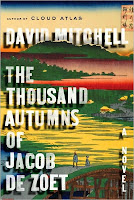
The Thousand Autumns of Jacob de Zoet

It's hard to describe David Mitchell's writing without falling into hyperbole. I will simply say that I think that he is one of the greatest living novelists in the English language, and leave it at that. His most recent book, "The Thousand Autumns of Jacob de Zoet" demonstrates the creative and imaginative power of his writing, even when his work is grounded some minor details of history.
The title character - Jacob de Zoet - is a young man assigned to help weed out corruption in Dejima, the exclusive trading post the Dutch hold in Japan. He originally joined the Trading Company while saving money to woo his lady-love back in Europe, but when faced with the grim realities of institutionalized corruption, he essentially becomes marooned in Dejima. Meanwhile, a Japanese midwife, whom he has developed feelings for, mysteriously disappears into a secret monastery. Trying to stay true to his original idealism is tough, especially when faced with cultural isolation, finding out the horrible secret of the local monastery, and - oh - a British warship demanding the unconditional surrender of the trading post.
It's hard to get into the intricacies of what makes Mitchell's novel so great without ruining what are a lot of great plot twists. Of course, this leads me to the first thing that makes this novel so great: the plot. Each of the three parts of the book are distinct from one another in terms of style and structure, but all are woven together through the characters.
--The first section of the novel follows Jacob de Zoet exclusively as he acclimates to the daily grind in Dejima. Being so far from his homeland, Jacob struggles to remain true to his idealistic ambitions: he is tempted by the potential profits from joining the corruption he intends to stop, and he dances near infidelity as he falls for the lovely, if scarred, Japanese midwife. This second ends as Jacob watches the Orito (the midwife) carried away, seemingly against her will, to a secretive local monastery.
--The second second section shifts entirely away from Jacob's story and focuses instead on Uzaemon, a translator, and his doomed attempt to rescue Orito when he finds out the monastery's horrible cultish precepts. Rather than the interior character study of the first section, the second part of the book is more action driven.
--The third section bounces around from character to character. At one point, it's even told from the perspective of one of the servants in Dejima. It is about halfway through this section that the intricate web that Mitchell has woven begins to come together, although the presence of a British warship threatens to blow the whole business to splinters.
Mitchell is a master of the little and not-so-little details and textual features that raise his novel to the highest levels of literature. One that comes to mind, is the constant presence of the stone strategy game Go. Understanding the game of Go - in which players place black and white stones on a grid to try to out-maneuver and capture enemy pieces - is critical to unlocking so much of the novel's complexity. One of the key characters, Lord Abbott Enomoto - leader of the monastery - is repeatedly seen playing Go. Meanwhile, he, and the other political figures in Nagasaki, are playing a game of Go with each other, constantly trying to "capture" political influence on one another. Uzeamon plays, and loses, when he attempts to "capture" Orito back from Enomoto. Jacob and Penhaligon (captain of the British vessel) play a deadly game of Go in the final confrontation. Some of these moments of strategy and tactics are interpersonal, while some are played out on a much larger scale. There's also the fact that the pieces in Go are black and white - suggesting a contrast between good and evil - which implies a lot when that is applied to the characters and situations in the book that relate back to Go.
The shifting perspectives in the novel, although superficially spice up the novel, support the underlying meaning of the novel, as well. As the plot becomes more chaotic and intense, the point of view shifts more and more often. This would be simple enough to increase the dramatic effect, but Mitchell uses it to also enhance the reading experience. At some points, through free indirect discourse, the reader is aware of what certain characters are thinking. But, at other points, the reader is left completely in the dark. At one point, jumping between two separate locations - the perspective shifts just before a critical moment, leaving the reader and the characters wondering why something happened. (I have to be a little vague here or it will essentially ruin the climax.)
On top of all this, Mitchell's attention to historical detail in this novel is well documented. To start, the presence of Dejima in Nagasaki as Europe's only trading post with an otherwise culturally isolated Japan is based in history. The British siege of Dejima, part of the novel's dramatic rising action and climax, is also based relatively accurately on a historical event. It has been reported that Mitchell lost whole days of writing while doing research for a single sentence about a minute historical detail. (The example of this recorded on Wikipedia is Mitchell trying to determine whether a character would have used shaving cream or not.)
To sum it all up (which I should have probably done long before now): "The Thousand Autumns of Jacob de Zoet" is a masterful piece of fiction which somehow (perhaps uniquely) balances between historical fiction and postmodern playfulness. I highly recommend it with the caveat that although the first chapters may seem dry, there are details contained therein which are critical to later sequences in the book. For those interested, based on my own somewhat limited reading, this is possibly Mitchell's most accessible book, and may be a good place to start.
Good luck, and happy reading! Seriously - enjoy this book because rarely does a reader find a book of this caliber. I'm relatively confident in my feeling that David Mitchell's work will prove to be some of the more lasting pieces of this age and era of literature. My words of recommendation here pale in comparison to Mitchell's work itself. (There goes that hyperbole again...)
Subscribe to:
Posts (Atom)


