Directed by: Joss Whedon
Written by: William Shakespeare (play); Joss Whedon (screenplay)
It's tough to do a modernized version of Shakespeare. Really tough. Most fall flat (see Ethan Hawke's "Hamlet") while those that don't totally fail are forced to rely on stylistic gimmicks (Baz Lurhrmann). Most don't even try to really modernize, but try exotic time periods and locations (Sir Kenneth Branagh).
Joss Whedon's "Much Ado About Nothing" succeeds. It's good.
I'm not sure what else to say except that Whedon's adaptation feels natural and organic. It doesn't go over-the-top. The choice to shoot in black-and-white film is a bit of a stretch at first, but quickly is forgotten and helps with the simple, straight-forward feel of the movie.
What surprised me most was the way the actors, especially character actors such as Nathan Fillion, manage to take total control of the Shakespearean language and make it sound totally natural. None of the conversations felt forced or over-wrought.
To be honest, it's been a long time (ten years or more) since I've read the original Shakespeare, so it's tough for me to judge the how much of the source material was scratched and molded to fit Whedon's vision. In any case, it worked.
Showing posts with label 2012. Show all posts
Sunday, May 31, 2015
Saturday, January 5, 2013
Skyfall
Directed by: Sam Mendes
Written by: Neal Purvis, Robert Wade, John Logan
Is this it? Is this the film that finally elevates James Bond from mere genre flick to, perhaps, maybe, actual film? My conclusion: maybe.
The third installment in the Daniel Craig iteration as 007 separates itself from the first two (2006's "Casino Royale" and 2008's "Quantum of Solace") while simultaneously establishing more connections to the earlier Bond worlds (the introduction and modernization of Q, for example).
Let's get straight to my point, though. This film has a lot more depth to it than most of the other Bond films. The characters actually have flaws! And backgrounds! Oh my! One of the hallmarks of everything Bond before "Skyfall"was the lack of background - as if nothing really existed before the moment the film began. Even one of Bond's most significant moments - the death of his wife in "On Her Majesty's Secret Service" - is all but ignored in every other movie in the series. This is the first movie (beyond a few casual references in "Casino Royale") that James Bond was once a little boy.
Suddenly, Bond is grounded in reality! Not only that, but he's actually lost a step or two (because of a minor plot point I'd rather not spoil here), and maybe isn't quite the agent he once was. He makes mistakes - major ones - which have ramifications throughout the whole movie. He's much more human than usual - almost weak - though he still kicks butt.
Mendes and the writers build into the story some recurring themes which help lift this film beyond the drudge of mere genre action. For example, every character is dealing with some major setback in their past - Bond, M, Eve, Silva (the villain) - which has thrust itself into their present lives. To overcome the drama of the present, though, they must confront and explore their pasts. This element leads to one of the most significant revelations about Bond's past - a visit to his childhood home named... Well... You'll have to see that for yourself.
There is also the recurring element of betrayal. Or, at least, actions which could easily be interpreted as betrayal. A significant portion of the film is spent with characters betraying each other, apologizing for betrayal, justifying betrayal, or recovering from betrayal. And all of it is rich and subtle and deep, except for the blatant symbolism at the climax of the film - a literal knife in the back - but I'll forgive them that.
So, the usual question that follows all this is "Where does 'Skyfall' land in the pantheon of Bond?" A lot of critics (especially the type quoted in advertisements) claim it's the best Bond film ever. Personally, I'm not a huge fan of "ranking" things, but much prefer categorization. Anyway, I would definitely list it in the same category as the other elite Bond movies. Well done!
Written by: Neal Purvis, Robert Wade, John Logan
Is this it? Is this the film that finally elevates James Bond from mere genre flick to, perhaps, maybe, actual film? My conclusion: maybe.
The third installment in the Daniel Craig iteration as 007 separates itself from the first two (2006's "Casino Royale" and 2008's "Quantum of Solace") while simultaneously establishing more connections to the earlier Bond worlds (the introduction and modernization of Q, for example).
Let's get straight to my point, though. This film has a lot more depth to it than most of the other Bond films. The characters actually have flaws! And backgrounds! Oh my! One of the hallmarks of everything Bond before "Skyfall"was the lack of background - as if nothing really existed before the moment the film began. Even one of Bond's most significant moments - the death of his wife in "On Her Majesty's Secret Service" - is all but ignored in every other movie in the series. This is the first movie (beyond a few casual references in "Casino Royale") that James Bond was once a little boy.
Suddenly, Bond is grounded in reality! Not only that, but he's actually lost a step or two (because of a minor plot point I'd rather not spoil here), and maybe isn't quite the agent he once was. He makes mistakes - major ones - which have ramifications throughout the whole movie. He's much more human than usual - almost weak - though he still kicks butt.
Mendes and the writers build into the story some recurring themes which help lift this film beyond the drudge of mere genre action. For example, every character is dealing with some major setback in their past - Bond, M, Eve, Silva (the villain) - which has thrust itself into their present lives. To overcome the drama of the present, though, they must confront and explore their pasts. This element leads to one of the most significant revelations about Bond's past - a visit to his childhood home named... Well... You'll have to see that for yourself.
There is also the recurring element of betrayal. Or, at least, actions which could easily be interpreted as betrayal. A significant portion of the film is spent with characters betraying each other, apologizing for betrayal, justifying betrayal, or recovering from betrayal. And all of it is rich and subtle and deep, except for the blatant symbolism at the climax of the film - a literal knife in the back - but I'll forgive them that.
So, the usual question that follows all this is "Where does 'Skyfall' land in the pantheon of Bond?" A lot of critics (especially the type quoted in advertisements) claim it's the best Bond film ever. Personally, I'm not a huge fan of "ranking" things, but much prefer categorization. Anyway, I would definitely list it in the same category as the other elite Bond movies. Well done!
Craigslist Joe
Directed by: Joseph Garner
The central question of the documentary "Craigslist Joe" is simple: Can a person survive an entire month using only the kindness of strangers via Craigslist? Starting from that point, Joseph Garner sets out to discover what "community" means in 21st century America. Leaving behind his entire life, he hits the road with whoever will drive him and stays where anyone has an extra room available.
"Craigslist Joe" was interesting, though I'm afraid I'm not sure it made a point. (Perhaps I wasn't paying enough attention?) Ostensibly, the filmmaker is attempting to find "community," but rather than providing an answer, the film meanders around the country, providing brief glimpses into the lives of those who are generous enough to post on Craigslist.
I found the movie interesting, but flawed. It didn't seem to have a point, and felt more like a video diary than a real documentary. (So, maybe that's where I'm missing the bigger picture?) Still, it's a interesting look into modern life and the many paths that are opened through the internet.
The central question of the documentary "Craigslist Joe" is simple: Can a person survive an entire month using only the kindness of strangers via Craigslist? Starting from that point, Joseph Garner sets out to discover what "community" means in 21st century America. Leaving behind his entire life, he hits the road with whoever will drive him and stays where anyone has an extra room available.
"Craigslist Joe" was interesting, though I'm afraid I'm not sure it made a point. (Perhaps I wasn't paying enough attention?) Ostensibly, the filmmaker is attempting to find "community," but rather than providing an answer, the film meanders around the country, providing brief glimpses into the lives of those who are generous enough to post on Craigslist.
I found the movie interesting, but flawed. It didn't seem to have a point, and felt more like a video diary than a real documentary. (So, maybe that's where I'm missing the bigger picture?) Still, it's a interesting look into modern life and the many paths that are opened through the internet.
Labels:
2012,
Craigslist Joe,
documentary,
Gina Keatley,
Joseph Garner,
Kristos Andrews,
streaming
Tuesday, January 1, 2013
Hitchcock
Directed by: Sacha Gervasi
Written by: John J. McLaughlin (screenplay); Stephen Rebello (book)
I'm not sure how accurate this film is, in terms of historical veracity. It is at least entertaining, as it tells the story of how Alfred Hitchcock came to make his landmark movie "Psycho." The storytelling is a bit clunky at points, and it could have probably used a little more editing focus (a few subplots disappear or fall flat), but it definitely has its charms. There are a lot of interesting shots of someone looking in on someone else, which obviously references the element in "Psycho," but also raises a lot of questions about the nature of making a film (not to mention suggesting something important about those of us who watch them).
Written by: John J. McLaughlin (screenplay); Stephen Rebello (book)
I'm not sure how accurate this film is, in terms of historical veracity. It is at least entertaining, as it tells the story of how Alfred Hitchcock came to make his landmark movie "Psycho." The storytelling is a bit clunky at points, and it could have probably used a little more editing focus (a few subplots disappear or fall flat), but it definitely has its charms. There are a lot of interesting shots of someone looking in on someone else, which obviously references the element in "Psycho," but also raises a lot of questions about the nature of making a film (not to mention suggesting something important about those of us who watch them).
Sleepwalk With Me
Directed by: Mike Birbiglia, Seth Barrish
Written by: Mike Birbiglia, Joe Birbiglia, Ira Glass, Seth Barrish
I've heard this story once or twice on "This American Life," and it's a very interesting story. Essentially, a sleepwalking disorder and a quest to become a comedian help Mike learn some important life lessons. Unfortunately, aside from a few funny scenes, it didn't really translate into the film medium as much as I had hoped. It may be worth watching if the story is new to you, but there isn't much added in the film that isn't already available elsewhere.
Written by: Mike Birbiglia, Joe Birbiglia, Ira Glass, Seth Barrish
I've heard this story once or twice on "This American Life," and it's a very interesting story. Essentially, a sleepwalking disorder and a quest to become a comedian help Mike learn some important life lessons. Unfortunately, aside from a few funny scenes, it didn't really translate into the film medium as much as I had hoped. It may be worth watching if the story is new to you, but there isn't much added in the film that isn't already available elsewhere.
Lincoln
Directed by: Steven Spielberg
Written by: Tony Kushner (screenplay); Doris Kearns Goodwin (book - "Team of Rivals)
Abraham Lincoln is such a massive figure in American history, that it's hard to believe that any one movie could reasonably define him. Of course, only Steven Spielberg could even reasonably attempt a movie of this scale. And, for the most part, he was pretty successful.
Part of the film's success lies in its relativey limited scope. "Lincoln" only shows the president at the peak of his leadership, nearing the end of the Civil War while he is trying to have the 14th Amendment passed and ratified.
Daniel Day-Lewis somehow becomes Lincoln (or, at least, how I always imagined him to be), but great performances are pretty much expected from him.
Written by: Tony Kushner (screenplay); Doris Kearns Goodwin (book - "Team of Rivals)
Abraham Lincoln is such a massive figure in American history, that it's hard to believe that any one movie could reasonably define him. Of course, only Steven Spielberg could even reasonably attempt a movie of this scale. And, for the most part, he was pretty successful.
Part of the film's success lies in its relativey limited scope. "Lincoln" only shows the president at the peak of his leadership, nearing the end of the Civil War while he is trying to have the 14th Amendment passed and ratified.
Daniel Day-Lewis somehow becomes Lincoln (or, at least, how I always imagined him to be), but great performances are pretty much expected from him.
Sunday, November 25, 2012
A Hologram for the King
Written by: Dave Eggers
Before going on, I wanted to take a moment to appreciate the cover of this book. It's intricate and ornate and, simply put, beautiful. From the moment you see this book, before you open a page, the book itself demands your attention and respect and, well, awe.
Eggers is a master, and he has created in "A Hologram for the King" another novel which, if written by someone else would be a masterpiece, but for Eggers is merely par for the course.
Eggers brings a straight and powerful tone to this novel, which gives the book a gravity which could have easily been lost. There are points in the novel which border on surreal and could easily corrupt the story's core, but which Eggers handles effortlessly in stride.
The setting of the story manages to simultaneously call on several points of reference: it's both ancient and modern. Empty, but full of mystery. The other side of the world, but achingly familiar.
"A Hologram for the King" is powerful, and hearkens back to an ancient Greek tragedy while also firmly planting itself as a novel for its own time.
Before going on, I wanted to take a moment to appreciate the cover of this book. It's intricate and ornate and, simply put, beautiful. From the moment you see this book, before you open a page, the book itself demands your attention and respect and, well, awe.
Eggers is a master, and he has created in "A Hologram for the King" another novel which, if written by someone else would be a masterpiece, but for Eggers is merely par for the course.
Eggers brings a straight and powerful tone to this novel, which gives the book a gravity which could have easily been lost. There are points in the novel which border on surreal and could easily corrupt the story's core, but which Eggers handles effortlessly in stride.
The setting of the story manages to simultaneously call on several points of reference: it's both ancient and modern. Empty, but full of mystery. The other side of the world, but achingly familiar.
"A Hologram for the King" is powerful, and hearkens back to an ancient Greek tragedy while also firmly planting itself as a novel for its own time.
Labels:
2012,
A Hologram for the King,
book,
Dave Eggers
Thursday, August 16, 2012
The Dark Knight Rises
Directed by: Christopher Nolan
Written by: Jonathan Nolan, Christopher Nolan (screenplay); Christopher Nolan, David S. Goyer (story)
There's been plenty already said about this movie all over the internet, and there's really not a whole lot I can add to it in any meaningful way. That being said, I'll limit my comments here to my own impressions and leave the larger debate for others.
I'm happy that this film pretty clearly ends the Bruce Wayne arc of Christopher Nolan's version of Batman. Obviously (if you've seen it), there's plenty of wiggle room for more Batman films in the future, but this film ends much of what began in "Batman Begins." The three films created their own cohesive unit, apart from anything that came before (and potentially anything else the studio tries to tag on). There were also enough references, both major (the League of Shadows) and minor (Cillian Murphey's brief appearance in each movie) that the movies felt like they belonged together rather than forced together.
I look forward to seeing all three movies - "Batman Begins," "The Dark Knight," and "The Dark Knight Rises" - together to see how Batman evolves from the beginning of the trilogy to the end. The different films show how he progresses so that, even though he's different at the beginning than at the end, it doesn't feel inconsistent or arbitrary. Rather, the events in the films have forced him to evolve.
I was pleasantly surprised by Anne Hathaway's performance. When her part was announced, I had serious doubts. Instead, her role was one of the most rich and complex characters in the entire series, and she pulled it off in a subtle but convincing way. I also enjoyed the way that the whole "Hey! It's Catwoman!" thing wasn't rubbed in the audiences face. In fact, it was the opposite. I don't recall the name Catwoman ever being mentioned, and her costume was sleek without being obnoxious. She was definitely one of the highlights of the film.
"The Dark Knight Rises" was not a perfect film. It was long, and - worse - felt long. There were a few plot twists which theoretically added to the drama, but really only managed to complicate things and make them unnecessarily longer. (For example: The threat of a nuclear explosion in an urban area has enough drama in and of itself. Why did they need to add the element of "there are three identical trucks and we don't know which truck the bomb is on" except to add a couple of extra scenes?)
Last, but not least: I heard Tom Hardy just fine. I'm not sure what everyone else was complaining about.
Written by: Jonathan Nolan, Christopher Nolan (screenplay); Christopher Nolan, David S. Goyer (story)
There's been plenty already said about this movie all over the internet, and there's really not a whole lot I can add to it in any meaningful way. That being said, I'll limit my comments here to my own impressions and leave the larger debate for others.
I'm happy that this film pretty clearly ends the Bruce Wayne arc of Christopher Nolan's version of Batman. Obviously (if you've seen it), there's plenty of wiggle room for more Batman films in the future, but this film ends much of what began in "Batman Begins." The three films created their own cohesive unit, apart from anything that came before (and potentially anything else the studio tries to tag on). There were also enough references, both major (the League of Shadows) and minor (Cillian Murphey's brief appearance in each movie) that the movies felt like they belonged together rather than forced together.
I look forward to seeing all three movies - "Batman Begins," "The Dark Knight," and "The Dark Knight Rises" - together to see how Batman evolves from the beginning of the trilogy to the end. The different films show how he progresses so that, even though he's different at the beginning than at the end, it doesn't feel inconsistent or arbitrary. Rather, the events in the films have forced him to evolve.
I was pleasantly surprised by Anne Hathaway's performance. When her part was announced, I had serious doubts. Instead, her role was one of the most rich and complex characters in the entire series, and she pulled it off in a subtle but convincing way. I also enjoyed the way that the whole "Hey! It's Catwoman!" thing wasn't rubbed in the audiences face. In fact, it was the opposite. I don't recall the name Catwoman ever being mentioned, and her costume was sleek without being obnoxious. She was definitely one of the highlights of the film.
"The Dark Knight Rises" was not a perfect film. It was long, and - worse - felt long. There were a few plot twists which theoretically added to the drama, but really only managed to complicate things and make them unnecessarily longer. (For example: The threat of a nuclear explosion in an urban area has enough drama in and of itself. Why did they need to add the element of "there are three identical trucks and we don't know which truck the bomb is on" except to add a couple of extra scenes?)
Last, but not least: I heard Tom Hardy just fine. I'm not sure what everyone else was complaining about.
Monday, August 13, 2012
Gods Without Men
Written by: Hari Kunzru
The book begins with a unique myth about Coyote the trickster, and takes off from there. The book jumps around between several characters and time periods, all of which revolve around mysterious events surrounding a strange arrangement of rocks in the Mojave desert.
The central story follows of Jaz, a computer engineer wrapped up developing a program which can compile random bits of unrelated information to predict future economic trends. When Jaz begins to worry about the implications of this model, he takes his wife and son out to California where, in the middle of the day, his son mysteriously disappears near a strange formation of rocks. A long time later, the boy is found, but Jaz struggles to bond with the boy and wonders what exactly happened out in the desert.
Interspersed between chapters are two other major sub-stories. The first tells of a researcher in the 1920s who loses the love of his life to another man. In an act of revenge, he frames the man as a kidnapper and rounds up a posse to track him down. A shootout occurs and the man is killed at the same odd rock formation. The other major sub-story describes the rise and fall of a cult whose leaders claim to be able to communicate with aliens life forms of a higher civilization. Where does this cult base their operations? At the finger-like outcropping of rocks which has been featured in all the other stories.
There are a few other characters and sections which add to the overall mystique of the book.
As a novel with a jumping structure, it does all right. It's not as good as "Cloud Atlas," but it does hold its own. The comparison between "Gods Without Men" and "Cloud Atlas" is easy to make. They both track vaguely interrelated stories over multiple time periods, showing how certain themes and human behaviors repeat themselves. The problem with "Gods Without Men" is that the characters - with the exception of the cuckolded man - fall very flat, and without them there is no reason for the reader to consider the larger implications of the book. By the end of the novel, the twists become predictable and cliche.
Still, it is neat to read a modern day "trickster" story, even if it's not a perfect novel.
The book begins with a unique myth about Coyote the trickster, and takes off from there. The book jumps around between several characters and time periods, all of which revolve around mysterious events surrounding a strange arrangement of rocks in the Mojave desert.
The central story follows of Jaz, a computer engineer wrapped up developing a program which can compile random bits of unrelated information to predict future economic trends. When Jaz begins to worry about the implications of this model, he takes his wife and son out to California where, in the middle of the day, his son mysteriously disappears near a strange formation of rocks. A long time later, the boy is found, but Jaz struggles to bond with the boy and wonders what exactly happened out in the desert.
Interspersed between chapters are two other major sub-stories. The first tells of a researcher in the 1920s who loses the love of his life to another man. In an act of revenge, he frames the man as a kidnapper and rounds up a posse to track him down. A shootout occurs and the man is killed at the same odd rock formation. The other major sub-story describes the rise and fall of a cult whose leaders claim to be able to communicate with aliens life forms of a higher civilization. Where does this cult base their operations? At the finger-like outcropping of rocks which has been featured in all the other stories.
There are a few other characters and sections which add to the overall mystique of the book.
As a novel with a jumping structure, it does all right. It's not as good as "Cloud Atlas," but it does hold its own. The comparison between "Gods Without Men" and "Cloud Atlas" is easy to make. They both track vaguely interrelated stories over multiple time periods, showing how certain themes and human behaviors repeat themselves. The problem with "Gods Without Men" is that the characters - with the exception of the cuckolded man - fall very flat, and without them there is no reason for the reader to consider the larger implications of the book. By the end of the novel, the twists become predictable and cliche.
Still, it is neat to read a modern day "trickster" story, even if it's not a perfect novel.
Labels:
2012,
book,
Gods Without Men,
Hari Kunzru
Monday, July 16, 2012
Moonrise Kingdom
Directed by: Wes Anderson
Written by: Wes Anderson, Roman Coppola
I've been a huge fan of Wes Anderson for years (though, considering I've never covered a film of his here, you probably wouldn't know it). I find his work to be complex, intelligent, and visually stunning. His films can be a bit abrasive if you don't know what you're getting in to, but require an open mind to understand what he's trying to convey.
"Moonrise Kingdom" tells the story of of Suzy (Hayward) and Sam (Gilman) - two young teenagers who decide to join their miseries together and run away into the wilderness. Being stuck on an island, the children are easily tracked down by the local police force (Willis) and Suzy's parents (Murray, McDormand), but with a little help from some friends Suzy and Sam decide to try one more daring escape.
There's so much to say about this film, I don't know where to start.
I'm amazed at how Wes Anderson was able to pull fantastic performances out of each of his actors. Even Bruce Willis, who has been phoning it in lately ("Cop Out," anybody?), is stellar as the sweet-but-not-smart police captain. Some of the supporting performances, such as Jason Schwartzman, Edward Norton, and Harvey Keitel, were great and could have stolen the show if the stars hadn't been perfect. Hayward and Gilman, with no previous experience in film, give the performances of a lifetime as the young couple at the heart of the story.
There is so much else I could talk about, but I'll cut it as short as I can: Wes Anderson knows how to make good movies. He understands how to create a fictional world which effectively mirrors reality, both in content (Suzy's science fiction books) and emotion (the love story). He uses all the tools of the filmmaking medium - set design, camera movement, coloring, musical cues - to enhance his film both as story and as art. I could point to almost any scene in the film as an example of how much depth the movie has.
I could go on and on, but I'd rather just encourage you to go see "Moonrise Kingdom" and enjoy it for yourself.
Written by: Wes Anderson, Roman Coppola
I've been a huge fan of Wes Anderson for years (though, considering I've never covered a film of his here, you probably wouldn't know it). I find his work to be complex, intelligent, and visually stunning. His films can be a bit abrasive if you don't know what you're getting in to, but require an open mind to understand what he's trying to convey.
"Moonrise Kingdom" tells the story of of Suzy (Hayward) and Sam (Gilman) - two young teenagers who decide to join their miseries together and run away into the wilderness. Being stuck on an island, the children are easily tracked down by the local police force (Willis) and Suzy's parents (Murray, McDormand), but with a little help from some friends Suzy and Sam decide to try one more daring escape.
There's so much to say about this film, I don't know where to start.
I'm amazed at how Wes Anderson was able to pull fantastic performances out of each of his actors. Even Bruce Willis, who has been phoning it in lately ("Cop Out," anybody?), is stellar as the sweet-but-not-smart police captain. Some of the supporting performances, such as Jason Schwartzman, Edward Norton, and Harvey Keitel, were great and could have stolen the show if the stars hadn't been perfect. Hayward and Gilman, with no previous experience in film, give the performances of a lifetime as the young couple at the heart of the story.
There is so much else I could talk about, but I'll cut it as short as I can: Wes Anderson knows how to make good movies. He understands how to create a fictional world which effectively mirrors reality, both in content (Suzy's science fiction books) and emotion (the love story). He uses all the tools of the filmmaking medium - set design, camera movement, coloring, musical cues - to enhance his film both as story and as art. I could point to almost any scene in the film as an example of how much depth the movie has.
I could go on and on, but I'd rather just encourage you to go see "Moonrise Kingdom" and enjoy it for yourself.
Friday, July 6, 2012
Big Miracle
Directed by: Ken Kwapis
Written by: Jack Amiel, Michael Begler (screenplay); Thomas Rose (book)
I usually don't buy in to heartwarming, feel-good, family movies. But this one far exceeded my expectations.
The year is 1988, and when a family of gray whales gets trapped in an icy bay, it's up to a local news reporter (Krasinski) and his nature loving ex-girlfriend (Barrymore) to try to save them. With the help of the local whaling community, an oil executive (Danson) desperate for good press, and a visit from a Russian ice-breaker, they put together a desperate plan to save the whales from certain death and set them free to migrate to warmer waters.
This movie is a total cornball. But I can't seem to find a reason to hate it, the way I feel like I should. What saves this movie is how absolutely genuine it feels, from top to bottom. Everybody involved seemed to be trying to make a good, wholesome movie. And they did. Had there been a single moment of self-reflection, or a single wink from any of the actors, the charade would have been over. Instead, it seems they managed to produce exactly the type of movie they wanted to make, no more and no less.
The word "wholesome" keeps coming to mind. I'm not going to argue that it's Oscar worthy (because it's not). But it's a decent movie. and a half-step above a lot of other junk out there.
(Technical note: I labeled this movie as "streaming," but I actually viewed it using On Demand.)
Written by: Jack Amiel, Michael Begler (screenplay); Thomas Rose (book)
I usually don't buy in to heartwarming, feel-good, family movies. But this one far exceeded my expectations.
The year is 1988, and when a family of gray whales gets trapped in an icy bay, it's up to a local news reporter (Krasinski) and his nature loving ex-girlfriend (Barrymore) to try to save them. With the help of the local whaling community, an oil executive (Danson) desperate for good press, and a visit from a Russian ice-breaker, they put together a desperate plan to save the whales from certain death and set them free to migrate to warmer waters.
This movie is a total cornball. But I can't seem to find a reason to hate it, the way I feel like I should. What saves this movie is how absolutely genuine it feels, from top to bottom. Everybody involved seemed to be trying to make a good, wholesome movie. And they did. Had there been a single moment of self-reflection, or a single wink from any of the actors, the charade would have been over. Instead, it seems they managed to produce exactly the type of movie they wanted to make, no more and no less.
The word "wholesome" keeps coming to mind. I'm not going to argue that it's Oscar worthy (because it's not). But it's a decent movie. and a half-step above a lot of other junk out there.
(Technical note: I labeled this movie as "streaming," but I actually viewed it using On Demand.)
Saturday, June 30, 2012
Prometheus
Directed by: Ridley Scott
Written by: Jon Spaihts, Damon Lindelof
The debate surrounding the different interpretations of "Prometheus" can be very simply summed up:
Thinker or stinker?
I've gone back and forth between both sides, and am now firmly in the "thinker" camp.
There are many reasons why. One, put very well by a friend whose opinion on films I take very seriously, is that the reviews that hail "Prometheus" as great tend to be very well thought out essays while the reviews that dismiss it tend to be very poorly written. Granted, this is not a very scientific analysis, but it does reveal something significant. Those viewers with very analytical minds were able to find a lot to appreciate in the movie, while those who were looking for a cheap thrill on a big screen were sorely disappointed.
And I initially understood their disappointment. I felt it myself. Watching the trailers, I was hoping for a full-on "Alien" reboot with lots of chests exploding and people blowing things up. When those things weren't there (actually they were, but more on that in a minute), I was left shaking and scratching my head. I had a bitter taste in my mouth, and spent some time wondering why I didn't see all the awesome things I was hoping to see. Then it hit me: those things I wanted to see were there, but I hadn't seen them because they weren't quite what I had anticipated.
Take, for example, the chest explosions that the original "Alien" movies made famous. There was really only one (maybe two?) of those in "Prometheus." But, stepping back, the essence of the chest explosions - life bursting forth mysteriously from something else - is littered throughout "Prometheus." It happens several times, (the alien squid baby being the most notable and memorable for reasons obvious to anyone who has seen the film). Numerous times something or someone thought dead, lifeless, devoid is revealed to be much more than they appear. It happens over and over again, but most of us weren't able to see it.
The biggest key to the movie is to stop thinking of it as part of the "Alien" series of films. Its connection to that series is significant, but incredibly thin. I've found the best way to think of it is as an episode of "Lost" (where writer Damon Lindelof made his fame). In "Prometheus" as in "Lost" there are clues, references, fleeting moments which point to something larger. Themes, images, symbols are repeated but never explained, leaving the viewer to ponder their meaning, if any (which, in turn, has led to some absolutely wonderful discussions). The film's ambiguity - its unwillingness to even hint at answers to its biggest questions - is what makes it a movie worth discussing.
Does the movie have some flaws? Sure. Some big ones, too. Characters do things that don't make any sense. Contradictions, like the planet being totally habitable except for those massive storms which will rip humans to shreds, are plenty.
But ultimately, the fact that there are so many discussions - and heated ones - tells me that there's something to "Prometheus" which makes it more than B-level sci-fi fodder. See it, ponder on it, reflect on it, and tell me how anyone can argue it isn't a "thinker."
Written by: Jon Spaihts, Damon Lindelof
The debate surrounding the different interpretations of "Prometheus" can be very simply summed up:
Thinker or stinker?
I've gone back and forth between both sides, and am now firmly in the "thinker" camp.
There are many reasons why. One, put very well by a friend whose opinion on films I take very seriously, is that the reviews that hail "Prometheus" as great tend to be very well thought out essays while the reviews that dismiss it tend to be very poorly written. Granted, this is not a very scientific analysis, but it does reveal something significant. Those viewers with very analytical minds were able to find a lot to appreciate in the movie, while those who were looking for a cheap thrill on a big screen were sorely disappointed.
And I initially understood their disappointment. I felt it myself. Watching the trailers, I was hoping for a full-on "Alien" reboot with lots of chests exploding and people blowing things up. When those things weren't there (actually they were, but more on that in a minute), I was left shaking and scratching my head. I had a bitter taste in my mouth, and spent some time wondering why I didn't see all the awesome things I was hoping to see. Then it hit me: those things I wanted to see were there, but I hadn't seen them because they weren't quite what I had anticipated.
Take, for example, the chest explosions that the original "Alien" movies made famous. There was really only one (maybe two?) of those in "Prometheus." But, stepping back, the essence of the chest explosions - life bursting forth mysteriously from something else - is littered throughout "Prometheus." It happens several times, (the alien squid baby being the most notable and memorable for reasons obvious to anyone who has seen the film). Numerous times something or someone thought dead, lifeless, devoid is revealed to be much more than they appear. It happens over and over again, but most of us weren't able to see it.
The biggest key to the movie is to stop thinking of it as part of the "Alien" series of films. Its connection to that series is significant, but incredibly thin. I've found the best way to think of it is as an episode of "Lost" (where writer Damon Lindelof made his fame). In "Prometheus" as in "Lost" there are clues, references, fleeting moments which point to something larger. Themes, images, symbols are repeated but never explained, leaving the viewer to ponder their meaning, if any (which, in turn, has led to some absolutely wonderful discussions). The film's ambiguity - its unwillingness to even hint at answers to its biggest questions - is what makes it a movie worth discussing.
Does the movie have some flaws? Sure. Some big ones, too. Characters do things that don't make any sense. Contradictions, like the planet being totally habitable except for those massive storms which will rip humans to shreds, are plenty.
But ultimately, the fact that there are so many discussions - and heated ones - tells me that there's something to "Prometheus" which makes it more than B-level sci-fi fodder. See it, ponder on it, reflect on it, and tell me how anyone can argue it isn't a "thinker."
Sunday, June 17, 2012
The Avengers
Directed by: Joss Whedon
Written by: Zak Penn, Joss Whedon
I have to admit, I was very late to the "Let's all go see 'The Avengers!'" bandwagon. Like, a month and a half late. I've had the problem lately that I get extremely excited about an upcoming blockbuster, but then lose almost all of the will to see it when the movie is finally showing in theaters.
The plot of "The Avengers," is pretty standard fare for a superhero flick. Bad guy Loki (Hiddleston) decides to align himself with some nasty aliens to take over the earth. Nick Fury (Jackson) decides to bring together a group of otherwise-unconnected heroes to fight off the evil onslaught. The heroes must realize that their concern for the survival of humanity trumps their individual personality conflicts. Action ensues; heroes win. (And sorry for that last spoiler.)
I've got to say that this movie was 100% what I expected it to be. Unfortunately, that was also it's biggest weakness. "The Avengers" played out pretty much exactly how I imagined it would, with a few inconsequential variables. There was never a moment where I thought, "Hey! I didn't see that coming!" The dialogue was sharp, as is expected from a Joss Whedon script, but the plot didn't deviate at all from the simple hero archetype.
Now, that being said, the movie was awesome. The effects were phenomenal. The actors really brought the characters to life. The action scenes were pretty fantastic. It hit every mark with flying colors.
A friend asked me what grade I'd give the movie. I said I'd give it a solid A. I'm just bummed there wasn't that extra-special moment to push it up to an A+.
Written by: Zak Penn, Joss Whedon
I have to admit, I was very late to the "Let's all go see 'The Avengers!'" bandwagon. Like, a month and a half late. I've had the problem lately that I get extremely excited about an upcoming blockbuster, but then lose almost all of the will to see it when the movie is finally showing in theaters.
The plot of "The Avengers," is pretty standard fare for a superhero flick. Bad guy Loki (Hiddleston) decides to align himself with some nasty aliens to take over the earth. Nick Fury (Jackson) decides to bring together a group of otherwise-unconnected heroes to fight off the evil onslaught. The heroes must realize that their concern for the survival of humanity trumps their individual personality conflicts. Action ensues; heroes win. (And sorry for that last spoiler.)
I've got to say that this movie was 100% what I expected it to be. Unfortunately, that was also it's biggest weakness. "The Avengers" played out pretty much exactly how I imagined it would, with a few inconsequential variables. There was never a moment where I thought, "Hey! I didn't see that coming!" The dialogue was sharp, as is expected from a Joss Whedon script, but the plot didn't deviate at all from the simple hero archetype.
Now, that being said, the movie was awesome. The effects were phenomenal. The actors really brought the characters to life. The action scenes were pretty fantastic. It hit every mark with flying colors.
A friend asked me what grade I'd give the movie. I said I'd give it a solid A. I'm just bummed there wasn't that extra-special moment to push it up to an A+.
Sunday, June 3, 2012
The Hunger Games
Directed by: Gary Ross
Written by: Gary Ross, Suzanne Collins, Billy Ray (screenplay); Suzanne Collins (novel)
An adaptation of the hit YA distopian novel, featuring just about as many stars (and up-and-coming stars) as could be crammed into a modern feature-length film.
Overall, it was a pretty well-made adaptation. In fact, some of the criticism has been that it was too close of an adaptation and lacked any originality. I agree, to an extent. The visual-effects were very loyal to the way everything was described in the novel, revealing things basically the way everyone imagined them. It might have been nice to see a little creative license taken with some of the way things were presented or perhaps in the way the story unfolded.
There were a few kinks in the novel-to-film transition: mainly, a few things were glossed over or awkwardly inserted. The stand-out example of this was the "tracker-jacker" explanation - the regular narrative stopped, pulled back to a sports commentary style to explain what the insects were, and then returned back into the regular narrative.
I enjoyed this movie very much. But I'm not sure if I actually enjoyed it, or if I liked the original "Hunger Games" concept.
Written by: Gary Ross, Suzanne Collins, Billy Ray (screenplay); Suzanne Collins (novel)
An adaptation of the hit YA distopian novel, featuring just about as many stars (and up-and-coming stars) as could be crammed into a modern feature-length film.
Overall, it was a pretty well-made adaptation. In fact, some of the criticism has been that it was too close of an adaptation and lacked any originality. I agree, to an extent. The visual-effects were very loyal to the way everything was described in the novel, revealing things basically the way everyone imagined them. It might have been nice to see a little creative license taken with some of the way things were presented or perhaps in the way the story unfolded.
There were a few kinks in the novel-to-film transition: mainly, a few things were glossed over or awkwardly inserted. The stand-out example of this was the "tracker-jacker" explanation - the regular narrative stopped, pulled back to a sports commentary style to explain what the insects were, and then returned back into the regular narrative.
I enjoyed this movie very much. But I'm not sure if I actually enjoyed it, or if I liked the original "Hunger Games" concept.
Monday, May 28, 2012
Kevin Smith: Burn in Hell
Directed by: Zak Knutson, Joey Figueroa
This is another installment in the series of Kevin Smith Q&A sessions. These clips were taken from one event filmed in Austin, Texas after a screening of Smith's film "Red State."
The best story he told - also, the longest - traced his conflict with an ultra-conservative church whose actions, to an extent, inspired the script for "Red State." He explained his combative relationship with the members of the church, as well as how he organized his counter-protests when they began attempting to picket screenings of his film.
For the first time, Smith's usually lighthearted demeanor took a slightly darker turn, as he discussed his father's death. Yet, never to let an opportunity pass, he uses it as a springboard to encourage everyone to get out and do something with their lives.
I'd highly recommend that you see "Red State" before seeing this. In fact, I'd recommend viewing all of Kevin Smith's movies and previous Q&A releases before seeing this. But if you're already a Kevin Smith geek, it's worth checking out.
This is another installment in the series of Kevin Smith Q&A sessions. These clips were taken from one event filmed in Austin, Texas after a screening of Smith's film "Red State."
The best story he told - also, the longest - traced his conflict with an ultra-conservative church whose actions, to an extent, inspired the script for "Red State." He explained his combative relationship with the members of the church, as well as how he organized his counter-protests when they began attempting to picket screenings of his film.
For the first time, Smith's usually lighthearted demeanor took a slightly darker turn, as he discussed his father's death. Yet, never to let an opportunity pass, he uses it as a springboard to encourage everyone to get out and do something with their lives.
I'd highly recommend that you see "Red State" before seeing this. In fact, I'd recommend viewing all of Kevin Smith's movies and previous Q&A releases before seeing this. But if you're already a Kevin Smith geek, it's worth checking out.
Labels:
2012,
Burn in Hell,
Joey Figueroa,
Kevin Smith,
Red State,
streaming,
Zak Knutson
Sunday, June 12, 2011
2012
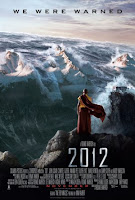
Directed by: Roland EmmerichWritten by: Roland Emmerich, Harald Kloser
With the Mayan calendar fast approaching its end in 2012, it was inevitable that the film industry would try to capitalize on people's fears of mortality. In this case, disaster film expert director Roland Emmerich was picked to put together perhaps the ultimate catastrophe movie.
The end of the world-as-we-know-it begins when a solar flare sets off some kind of chain reaction which will cause the earth's crust to shift dramatically. International governments (including the American president played by Danny Glover) decide not to tell, but instead begin a secret project to attempt to save the human race. Meanwhile, most normal people (including John Cusack cast, oddly enough, as a chauffeur) begin to notice that weather disasters, such as tornadoes and earthquakes, are happening more frequently and with more intensity. Eventually, the civilized world begins to crumble as a chosen few desperately try to reach the international safe-haven in China.
There is a lot that goes wrong in this movie (and I'm not talking about the disasters), but let's start with the good.
Woody Harrelson. Woody Harrelson plays a back-woods government-conspiracy fearing lunatic radio broadcaster who tips off John Cusack's character that there may be more going on than meets the eye. Harrelson's character is by far the most fun and interesting, and it's unfortunate that he ends up with so little screen time.
Now on to what's wrong with this film - everything else!
To begin, the movie is entirely too long. Coming in at over two and a half hours, the movie is unnecessarily bloated and drags on far to long at many points. Some suggestions on how to cut? Start with the absurdly large cast. There are too many characters that the film tries to follow, and by the end the audience doesn't really care about any of them. For example, the entire subplot about the Russian billionaire's mistress having an affair with his pilot could be cut - it adds nothing to the film whatsoever, but consumes at least ten minutes of screen time. The same with the subplot about the scientist from India - not sure what he's doing in the movie at all.
Now, usually, when one goes to see a disaster movie, they expect to see some whopping special effects. Usually. Apparently Emmerich (who otherwise has a pretty good track record) missed the memo on this one. The special effects were underwhelming and unimpressive, and, after a while, repetitive. There are only so many "giant earthquakes toppling skyscrapers" sequences that a person can see before they lose their meaning. (One highlight, though, was the scene in which Cusack's car is being chased by a collapsing LA freeway - instant classic moment!)
The movie seemed to overlap and repeat itself too many times. It's easy to lose track of how many times someone says "It's happening sooner than expected" (or something along those lines). And there are three - literally three - scenes at an airport in which a plane has to take off in the midst of disaster on the runway. Sure, they happened at different airports, but a little variety in the disaster drama might have gone a long way.
Typically, I enjoy these types of movies for what they are. But in this case, I'd just had enough by the end of the movie. I'd only recommend this movie if you can't see any of Emmerich's other epic disaster movies. For what they're worth, "The Day After Tomorrow" and "Independence Day" give a much better bang-to-buck return. Sorry "2012" - maybe you'll be more exciting next year, but I'm not holding my breath.
Subscribe to:
Posts (Atom)


