Wednesday, February 29, 2012

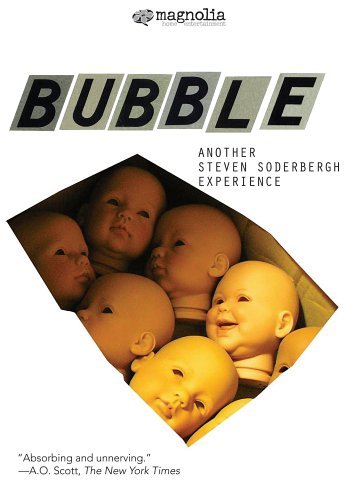
Bubble

Directed by: Steven Soderbergh

Written by: Coleman Hough


To start: we were inspired to watch this movie after seeing it as one of Roger Ebert's "Netflix Instant Pick-of-the-Day" selections.

Life in small-town Ohio is pretty dull, and Kyle spends most of his time making body parts at a doll factory. That is, until the mysterious Rose shows up. Kyle and Rose begin a romantic relationship (which includes Rose stealing some cash from an unknowing Kyle), much to the chagrin of Debbie, one of Kyle's older co-workers. When Rose ends up dead, the suspect list is quickly narrowed down to Debbie, who denies it to the very end.

This is a small movie for Soderbergh. Its topic is small. The setting is small. The dialogue is minimal. Even the length of the film is under-average. But the scope of the movie doesn't detract from Soderberg's ability to create a powerful, vibrant film.

The visuals in this film, especially the footage at the doll factory, are stunning and brutal yet beautiful. The camera feels distant from the action, even during close-ups, which almost gives the effect of a scientific examination rather than a fictional drama. The murder feels both absurd and realistic at the same time. All of this adds up to a sense that this movie retains its fictional angle while also showing merely a slightly distorted image of a reality that could be.

It's hard to say I enjoyed this movie, given its bleak perspective, but it's definitely a movie worth seeing.

Catching Fire

Written by: Suzanne Collins


This second book in the "Hunger Games" trilogy picks up, almost literally, where the first book left off.

Katniss has returned to her home in District 12, survivor of the brutal Hunger Games. But there are rumors of uprisings in other districts inspired by her acts of defiance against the cruel Capitol. President Snow puts pressure on Katniss to smooth things over. But when she fails to do so, he uses his power to call Katniss for the extra-brutal "Quarter Quell" edition of the Hunger Games. How will she fare against in another game of life-or-death against other Hunger Games survivors? And will she be able to survive now that President Snow needs her dead in order to retain control of the dissenting districts?

I'm not going to lie - I was very disappointed in this book. To be honest (and, hey - spoilers ahead), most of this book is a re-hashing of the first book. First, there are the constant reflections and reminders of what happened in the first book. Then, there is literally another edition of the Hunger Games. Granted, there are a few twists, but it felt very derivative of the original. Never before has a sequel felt so directly reliant on the original.

To continue piling on the negatives: The romantic triangle dilemma that Katniss finds herself in, caught between Peeta and Gale. Honestly, neither of the male characters have much definition, and there's no clear reason to pick one over the other. Rather, Peeta and Gale seem to be slightly altered mirror images of each other. A role of the dice could make the decision, and would probably be the best strategy.

Once you get through all the negatives, though, there's a skeleton of a good novel here. As soon as the Quarter Quell begins, the story becomes filled with action - and so takes off. Collins should stick with the action sequences, as Katniss's internal struggles merely bog the novel down.

Honestly, I felt this novel was just filler material between the first novel and the conclusion. I'm not sure how much it added to the story material. The twist conclusion - which, by far, was the best part - felt somewhat like an excuse to get Katniss from Point A to Point C.

Vertigo

Directed by: Alfred Hitchcock

Written by: Alec Coppel, Samuel A. Taylor (screenplay); Pierre Boileau, Thomas Narcejac (novel)


It may hard to imagine now, but Hitchock's masterpiece "Vertigo" was apparently not well received when it was released. In retrospect, though, it is clear what a cinematic achievement the film represents, and its influence is hard to ignore.

Detective Scottie Ferguson (Stewart) has been forced into retirement after a terrible accident in which his acrophobia resulted in the death of another officer. But when his old friend Gavin Elster (Heldmore) asks him to follow his wife Madeline (Novak) around, Ferguson agrees to take the job on. It seems that Madeline is periodically possessed by the spirit of one of her ancestors, and Ferguson becomes obsessed with breaking her of this problem until she throws herself from a church bell tower. Her death, though, is not the end, and nothing is quite as it seems.

The film starts off slow - almost tediously slow. As Ferguson stalks Madeline around various locales in San Francisco, there are long droughts lacking dialogue or meaningful action. But be patient - the payoff is absolutely worth it. (Also, it's fun to look at old San Francisco.)

There are several major twists placed throughout the story, so don't get too comfortable thinking you know what is going on. I'd seen this movie before several years before, and I was still surprised at one point. There are layers and stories-within-stories which can make trying to follow along somewhat dizzying. (Hence, the title.)

This may not be James Stewart's most spectacular performance, but it is definitely one of his most believable. After a few early scenes, he easily shakes off that "Hey, you're watching Jimmy Stewart!" feeling. He manages to play his character subtly, providing him a rich range of feelings without necessarily needing to show all those feelings.

Lastly, it was fun to see the film which plays such a large part in another one of my favorite films - "Twelve Monkeys."

"Vertigo" is an excellent starting-off point for those unfamiliar with Hitchcock's work. It is easily the most accessible film while also being representative of his style. It is absolutely a classic.

Sunday, February 5, 2012

Tinker Tailor Soldier Spy

Directed by: Tomas Alfredson

Written by: Bridget O'Connor (screenplay), Peter Straughan (screenplay), John le Carré (novel)


I reviewed the original novel here not too long ago, so I won't bother mentioning a plot summary. Let's just move straight into analysis here.

Going into it, I was worried that the running time of the film would require huge chunks of the novel to be truncated. The screenwriters did a fantastic job of keeping the core story together while making only minor alterations to the side stories. Aside from opening the film with what happened on the operation in Hungary (which is not revealed until near the end of the novel), the most important elements of the story were kept almost entirely intact.

The acting performances are all superb. Gary Oldman is excellent as George Smiley, though the character is intended to be mild-mannered and quiet. All of the supporting cast, such as Tom Hardy and Benedict Cumberbatch, really shine in their smaller parts.

Some of the symbolism, especially the bloody tear drop at the end, was a bit heavy-handed.

I did have one major blind spot in regards to this film - I'd already read the novel, so I knew what was going on. The major criticism I've heard in regards to this film is that so much of what goes on is very subtle that it becomes very hard to follow. I was able to follow it fine, but I can see where it might have been confusing for those not already familiar, especially in regards to the Ricki Tarr flashbacks and the sting operation at the end. There are also many tertiary characters - such as Bland, Alleline, and that bunch - whose roles and jobs are much more clear in the novel but are inserted in the film with little to no explanation.

It's nice to see a good spy film that doesn't resort to James Bond style action. The ideas of espionage and double-agents have fallen into darkness when it comes to spy stories. It was nice to see them revived.

Overall, I'd recommend this film. It's a bit long, but well worth it, if only for Oldman and Hardy's performances.

Saturday, February 4, 2012

Dazed and Confused

Written and Directed by: Richard Linklater


A period piece? A coming-of-age story? The ultimate party movie? All of the above!

It's pretty much impossible to describe the plot of Linklater's film. On the last day of school, the local high school seniors gang up to haze the incoming freshmen. Some are on the verge of major decisions about their future, while others have decided not to worry about things. And they all converge at a major party.

Linklater is to be applauded for making such a charming and powerful movie. At the surface level, it could easily be confused for a mere party film, but repeat viewings reveal much deeper substance. It manages to be a period piece on mid 1970s, but also has the ability to speak to multiple generations.

The costume design is one-of-a-kind. The retro fashion used effectively evokes the brashness of the 1970s, but avoids being disrespectful or over-the-top. Rather, it creates a sense of verisimilitude, making the world feel real and lived-in.

The ensemble cast really glues the film together. They manage to believably convey the angst and confusion of adolescent life, as well as effectively portraying life at the time. Special credit needs to be given to Matthew McConaughey for a spectacular performance as the perv that never quite leaves high school. (And you know there was at least one of those at your high school too.) Ben Affleck's part is also quite memorable, if a bit over-played. It's the kind of part we'll never see him perform again.

Despite the greatness of the film, it can be a bit hard to sit through. Lacking a dramatic plot, much of the movie feels a bit listless and directionless. I imagine it might be better viewing in a setting devoid of distractions. Alcohol and friends may also enhance the viewing experience.

"Dazed and Confused" is worth watching repeatedly.

Sunday, January 29, 2012

Tinker Tailor Soldier Spy


Nowadays it seems like the "spy" genre is filled with fast paced James Bond style action. But John le Carré's novel "Tinker Tailor Soldier Spy" is quite the opposite.

After a blown spy mission behind enemy lines, major shifts in power have taken place in the British spy agencies. When vague but relevant evidence reveals that there may be a Russian mole near the top of the British secret service, retired agent George Smiley is put on the job to investigate. And as Smiley gets closer to the mole's identity, he also gets closer to figuring out what happened on that blown mission and why he was forced into retirement.

The novel's plot is delicately paced, but executed perfectly. It's slow, but it is deliberately slow. The story unwinds - going back and forth through time - until everything has been revealed. To be honest, at times it can wear on the reader's patience, but when the truth is revealed the novel is redeemed.

George Smiley - through whose eyes we see most of the novel, indirectly - is an interesting character. He has his obvious weaknesses, but a keenness with which he uses those weaknesses to his own advantage (if that can be understood and believed).

The book is weakest in terms of its length. There are many sequences in which we're provided detail after detail. Some of those details become quite important, but it's hard to parse those out as you read. Instead, there are huge monologues and flashbacks that the reader must pay attention to, even if the reader is unsure what they are paying attention for. This perspective puts the reader in almost the same position as the protagonist - trying to pull out the meaningful details from a hodgepodge of rumors and hearsay.

In fact, the process of finding out who the spy is dwarfs just about everything else, even to the point that the big reveal - when we finally find out who the Russian mole is - is almost anti-climactic. (This isn't to say that the reveal isn't important or exciting, though.)

Overall, it's an excellent novel. It is unique and well written, and definitely a cut or two above the usual pulp spy novel.

Carnage

Directed by: Roman Polanski

Written by: Yasmina Reza, Roman Polanski


Based on Yasmina Reza's play "The God of Carnage," this film tells the story of two couples who have come together to settle a violent incident between their two children. But the road to hell is paved with good intentions, and things quickly turn sour between the two couples. Each character begins to suffer from various personal and emotional breakdowns as the dynamics of power and conflict continually shift, with the help of a few spontaneous moments (including one of the characters vomiting).

Personal and legal issues aside (and they are are to ignore), Polanski should be applauded for making such an emotionally intense film. The total running time is less than ninety minutes, but every minute is jam packed with tension. Adding any more length would have been more of the same.

As it is based on a play, the entire action of the film takes place in a single day within a single apartment. Polanski's use of close-ups and stationary cameras helps to enhance the claustrophobic effect. The characters pace around the rooms like animals in a cage.

Each of the actors does a fantastic job. Jodie Foster plays an uptight liberal mother better than any. (This is high praise, considering that I'm not a huge Foster fan.) John C. Reilly plays his usual slightly above-average Joe.

This movie is fantastic. It's hard to say I "enjoyed" it, but it is definitely worth seeing.