Directed by: John Huston
Written by: John Huston (screenplay); Dashiell Hammett (novel)
"The Maltese Falcon" stands as one of the essential and archetypal P.I. films. When parodies of private detectives arise in pop culture - the Prairie Home Companion segment "Guy Noir" comes to mind - it is usually based on this (and a bit of Raymond Chandler's Philip Marlowe as well).
Beyond it's place as a cultural touchstone, "The Maltese Falcon" is still a pretty good film as well.
The story surrounds every character doing whatever they can - including murder - to acquire the priceless statue named in the title. Detective Sam Spade (Bogart) gets drawn into drama when his partner is killed. From there it is a game of cat and mouse, lies and half-truths until the location and possession of the statue is resolved (with one final twist I won't give away here).
The plot development is a bit rough at points, as characters lie and mislead each other as well as the audience. This can be frustrating, but ultimately everything is resolved and explained. It's a fun ride, though, and well worth watching.
Showing posts with label Humphrey Bogart. Show all posts
Tuesday, July 16, 2013
Casablanca
Directed by: Michael Curtiz
Screenplay written by: Julius J. Epstein, Philip G. Epstein, Howard Koch
Play written by: Murray Burnett, Joan Alison
Where do I even start with this movie? If I were forced to make a list of all-time great movies, this one would have to lead the list. It is nearly perfect in every way, and I can't say how many times I've watched it. No matter how many times I watch it, though, I'm still surprised by little details here and there. I've seen it on TV, VHS, DVD, and in multiple theaters (and I'm working on convincing myself that I need the Blu-Ray edition, as well). It is as entrenched in my heart as it is in the culture.
This film is the essential performance by Humphrey Bogart. His presence dominates the movie from beginning to end. He is at times brash, witty, quiet, bossy, contemplative, humorous, romantic, and heartless - all over the course of an hour and forty-two minutes. It is impossible for me to imagine this film with anyone else in the lead, despite stories that he was not the first choice.
The rest of the cast is just as great as Bogart. Ingrid Bergman exposes her character's tortured heart through her eyes and a the pitch of her voice. Claude Rains establishes his Captain Renault as one of the slimiest, most corrupt police officials ever. Even Peter Lorre's brief lines are enough for him to make his character powerful and sympathetic.
With repeat viewings, some of the subtlety of Michael Curtiz's direction has revealed itself as just as important as the performances. For example, when we first meet our protagonist, the audience sees his hands first - holding a cigarette, playing chess, and signing a check. This first moment, before we ever see his face or hear his voice, establishes Rick as a man in control of many things at once - which will play out over the course of the film. Later, the tension between the characters is drawn out until a flashback sequence (which I usually despise) fills in some of the gaps, while also leaving enough unexplained to keep the audience paying attention.
See this movie. See it now.
Screenplay written by: Julius J. Epstein, Philip G. Epstein, Howard Koch
Play written by: Murray Burnett, Joan Alison
Where do I even start with this movie? If I were forced to make a list of all-time great movies, this one would have to lead the list. It is nearly perfect in every way, and I can't say how many times I've watched it. No matter how many times I watch it, though, I'm still surprised by little details here and there. I've seen it on TV, VHS, DVD, and in multiple theaters (and I'm working on convincing myself that I need the Blu-Ray edition, as well). It is as entrenched in my heart as it is in the culture.
This film is the essential performance by Humphrey Bogart. His presence dominates the movie from beginning to end. He is at times brash, witty, quiet, bossy, contemplative, humorous, romantic, and heartless - all over the course of an hour and forty-two minutes. It is impossible for me to imagine this film with anyone else in the lead, despite stories that he was not the first choice.
The rest of the cast is just as great as Bogart. Ingrid Bergman exposes her character's tortured heart through her eyes and a the pitch of her voice. Claude Rains establishes his Captain Renault as one of the slimiest, most corrupt police officials ever. Even Peter Lorre's brief lines are enough for him to make his character powerful and sympathetic.
With repeat viewings, some of the subtlety of Michael Curtiz's direction has revealed itself as just as important as the performances. For example, when we first meet our protagonist, the audience sees his hands first - holding a cigarette, playing chess, and signing a check. This first moment, before we ever see his face or hear his voice, establishes Rick as a man in control of many things at once - which will play out over the course of the film. Later, the tension between the characters is drawn out until a flashback sequence (which I usually despise) fills in some of the gaps, while also leaving enough unexplained to keep the audience paying attention.
See this movie. See it now.
Sunday, May 22, 2011
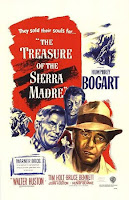
The Treasure of the Sierra Madre
Directed by: John HustonWritten by: John Huston (screenplay); B. Traven (novel)
A few weeks ago, I dragged The Wifey to our local theatre's Classic Film Wednesday presentation of "The Treasure of the Sierra Madre." When I was growing up, my dad always pointed to this movie as one of his favorites, though I never quite found the time to see it. Going through a VHS buying binge during college - with local stores clearing out used VHS tapes for as low as a dollar - I picked up a copy, watched it, and immediately fell in love with it.
As the movie begins, Fred C. Dobbs (Bogart) and his friend Bob Curtin (Holt) are American tramps living down-and-out in Tampico, Mexico. After being swindled one too many times, they downheartedly start hoping for just enough money to slip through the rest of their lives. One night at a flophouse, they encounter Howard (Huston), an old miner who promises them modest riches of gold for a few months of hard work. Although their ambitions begin small, as the gold piles up, leading to greed and paranoia between the small mining crew...
Humphrey Bogart's performance as Dobbs is masterful without being overpowering, which is especially impressive considering the attention the role calls to itself. But it is the supporting cast - Tim Holt and Walter Huston - which really carry the film. Holt brings an honesty, bordering on naivete, to his character's hard-work ethic. Huston's ability to remain ambiguous and non-committal at key moments in the film help the audience feel the stress that Dobbs is feeling, fueling his paranoia. And no one who has heard Huston's dry cackle, conspicuously used at significant moments of the film, can ever forget it.
There are also some great subtle moments used to hammer home important concepts. For example, early in the movie, Bogart gets a shave, a haircut, and some clean clothes. Yet, out in the wilderness, as his madness grows, he begins to pay less and less attention to his hygiene. His clothes become stained and his beard grows ragged. There's also some early foreshadowing of Dobb's descent into greed, as he repeatedly begs the same man for money for a meal which he then spends somewhat wastefully.
If there is any complaint about the movie, it's simply that it suffers from a distinct lack of modern pacing. Considering the film's length, not much actually happens. What the movie lacks in terms of plot development, though, it makes up for in character study. The audience is hypnotized by Dobb's madness, wondering how far he will go to keep his gold (which, without spoiling anything, is pretty far).
I won't get into this film being a pretty strong moral allegory against the selfish greed that sometimes rises in capitalism, as represented by Dobbs. It's there if you look for it, although I'll admit it would be a bit of a stretch.
"The Treasure of the Sierra Madre" is a wonderful example of how well were made back during the golden age of film. Without massive special effects or tons of star power (although Bogart brought plenty himself), the overall film is incredibly effective. I highly recommend it, although you do need to make sure you have plenty of time set aside - it's long.
Subscribe to:
Posts (Atom)

